Kenny Carter - Coach Carter
Thursday, October 16, 2008 | Football
By: Dan Apple, UF Communications
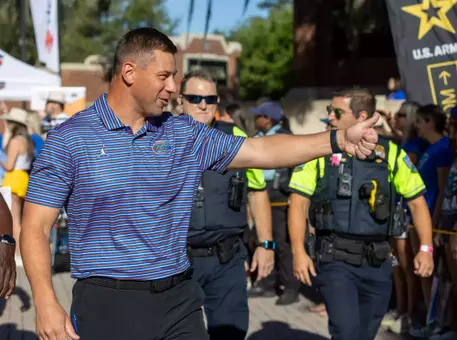
When offensive coordinator Dan Mullen called to see if Kenny Carter was interested in the coaching vacancy at Florida, Carter didn't even have to think twice.
“Obviously, it's Florida, I told him I would be interested,” said Carter. “If you're a competitor and want to be in a place to win a national championship, this is one of the places in the country that at the start of every season you have that opportunity.”
That opportunity is something that Carter has looked forward to throughout his career as a coach. He brings a wealth of experience and knowledge to the table, as he has coached at six previous schools and worked with five different position groups.
Carter got his coaching start at Furman in 1993, coaching the tight ends. After one year with the Paladins, he returned to his alma mater in Charleston, S.C. Carter, who played linebacker for The Citadel from 1986-89, rejoined the Bulldogs as the defensive ends and running backs coach, also serving as the recruiting coordinator from 1994-96.
After the '96 season, Carter was promoted to Assistant Head Coach, a position he held until 1999 when he moved on to LSU. He got some invaluable experience coaching outside linebackers against some of the best teams in the country in the SEC.
Carter's next stop was at Pittsburgh, returning to the offensive side of the ball and coaching the running backs. While at Pitt, Carter coached a running backs' group that included 1,000-yard rusher Kevan Barlow, who went on to play seven years in the NFL with the New York Jets and San Francisco 49ers.
In 2001, Carter moved on to the Big Ten, taking a position to coach the wide receivers at Penn State under the legendary Joe Paterno. Receiver Bryant Johnson was picked in the first round of the 2003 NFL Draft by the 49ers after hauling in the fourth-most receptions (110 catches) and the second-most receiving yards (2,008 yards) in school history under Carter's tutelage.
Carter returned to the SEC in 2004 as the running backs coach and recruiting coordinator at Vanderbilt. The Gators were forced to take notice of Carter when his Commodores ran for 254 yards against UF during his first season there.
During the 2007 season with Vanderbilt, Carter's running back trio of Cassen Jackson-Garrison, Jared Hawkins and Jeff Jennings combined for 1,207 yards, almost double what Florida's running backs gained in 2007 (the duo of Kestahn Moore and Brandon James rushed for 713 yards). This is exactly why head coach Urban Meyer wanted to bring in someone like Carter.
“One of the reasons I wanted to come to Florida, and accepted the job, is because when Coach Meyer and I had this conversation, this is one of the things that we want to try to alleviate,” said Carter.
Through five games this season, Florida's group of running backs has combined for 532 yards. If this pace continues, the unit will be on pace to rush for 1,280 yards in their 12 regular-season games. Part of Carter's philosophy is to have a successful position group, not necessarily one standout player.
“If we have one guy rush for 1,000 yards, outstanding,” said Carter. “But if we have a collection of guys that rush for more than 1,000 yards, then we're getting production out of the position, which is more important. In the end, it all comes down to how many yards you rushed for. Ultimately, it doesn't matter who rushed for what. What matters is what we produce from that position and how many wins you have at the end of the season.”
Having a 1,000-yard rusher would be nice, but history at Florida shows that it is a rare thing. In school history, there have only been seven individuals rush for over 1,000 yards in a season. That list includes such players as Emmitt Smith (the NFL all-time leading rusher), Erict Rhett (the all-time leader in rushing at UF) and Fred Taylor (an NFL Pro-Bowler and second-leading rusher among active NFL players).
The transition to Florida should come easy for Coach Carter, partly because he has a stable full of talented running backs. Senior leader Moore, the slippery James, Southern Cal transfer Emmanuel Moody and speedsters Chris Rainey and Jeff Demps.
“My impression is that we have the talent to be as good as anyone else in the country at that position,” said Carter. “What it comes down to is we have to apply it to the game and be consistent in our performance.”
Hopefully, Carter's backs can be successful enough to land him a head coaching job in the future. His experience coaching a multitude of position groups on both sides of the ball will certainly help him.
“The thing is, if you have aspirations of being a head coach, it behooves you to have experience on both sides of the ball,” said Carter. “I want to be a head coach at some point, and one of my mentors in the profession told me not to be afraid to [coach on both sides of the ball] – and if you can do it at the I-A level, the better.”
The different positions Carter has held over the years have allowed him to learn the specifics of most positions as well as the many different offensive and defensive schemes.
For now, Carter is glad he made the move to Gainesville to become a part of The Gator Nation.
“Everybody aspires to be at the pinnacle of their profession. That's what I feel like Florida is. If you have an opportunity to coach at one of the best schools in the country, why not take that chance?”