Gator Talk - Ups and Downs Precede Success
Sunday, September 26, 2010 | Football
By Norm Carlson, Assistant Athletics Director/Gator Historian
The exciting decade of the 1920's started slipping away two days before the annual Florida-Georgia game in 1929, and it would be over 20 years before Gator football would begin to rebound and head in the direction that the program now maintains.
The “Great Depression” started with the stock market crash on Thursday, Oct. 24, of that year. That Saturday, Florida defeated the Bulldogs, 18-6. The Gators entered the contest as a two-touchdown underdog but Clyde (Cannonball) Crabtree put on a show, throwing a TD pass to Dale Van Sickel, Florida's first All-American football player, and returning an interception 30 yards for another score.
Little did the crowd know that the economic chaos that began 48 hours before that kickoff would send the nation's economy into doldrums that would last thru the 1930's and be followed by World War II. It would be over 20 years before Gator football would begin to rebound and start resembling the force it has become.
The Depression, along with a Mediterranean fruit fly epidemic which destroyed the state's citrus crop and a hurricane which crippled the sugar industry in the Everglades, resulted in near bankruptcy for the State of Florida. University of Florida president Dr. John J. Tigert had to eliminate countless positions on campus in an effort to balance the budget, and funds for athletics were slashed. Most of UF's athletes were veterans returning on the GI Bill or freshmen straight out of high school, many of whom were not on scholarship.
The result was a record of 42-51-6 in the 1930's and a 33-52-3 performance in the 1940's. Four head coaches came and went. Florida became a charter member of the Southeastern Conference in 1933, but the school's league record at the end of the 1949 season was a dismal 18-57-5, the worst of any school by a wide margin. When Bob Woodruff took over as head football coach and athletic director for the Gators, he inherited a program which won only six SEC games in the previous decade.
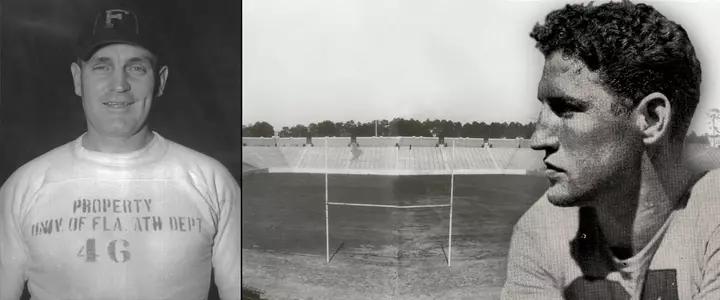
The best coaching job at Florida in the 1940's was done by Tom Lieb, even though the record might not look that way (20-26-1). Lieb coached from 1940-45 and saw his teams change personnel almost daily due to World War II. His varsity class of 1940-41 disappeared to the military, there was not a Gator team in 1943 and his 1944 and 1945 classes were almost entirely freshmen and veterans who were 4-F and couldn't enter the service.
Some of the finest football players in school history played during these years. Walter Mayberry of Daytona Beach was a three-year starter and the initial All-SEC player at Florida in 1937. Record-setting end Fergie Ferguson was the second All-American at UF in 1941 and also a national champion in the javelin. Both were heroes in World War II who paid with their lives for their country.
Florida posted 6-3-1 records in 1930 and 1934, the best mark during that 20-year period. The Gators also lost 13-straight games, from the last game of 1945 through the third game of 1947. That group nicknamed its period the “Golden Era'” although many said it meant “Golden Error.”
One of the best running backs in the nation was the star of the 1948-49 teams. Chuck Hunsinger broke school records and ran for four touchdowns to help the Gators break a seven-game losing streak to Georgia during a 28-7 win in 1949.
Adversity created a bond among the players, who continued to meet as a group for decades following graduation. The best league finish was sixth in both 1934 and 1938, and the worst was 11th in the 0-9 season of 1946. The average finish was just under ninth.
Most fans agree that these are good times for Gators. When you examine where UF has come from, these years should be appreciated even more and not taken for granted.