Gator Coaching Staff Welcomes Video Monitors ? and Instant Replays ? to Coaching Booth
Tuesday, August 30, 2011 | Football, Scott Carter
GAINESVILLE, Fla. – Raise your hand if you have experienced this on a Saturday afternoon. You're watching a college football game at home, there's a controversial call on the field, and then you watch the replay on your high-definition big-screen TV.
Once you take a couple of looks at the play in slow motion, you grit your teeth because it's easy to see that the call against your team is the right one. But wait, the play isn't over yet.
As soon as you accept reality and your blood pressure drops back to normal, the head coach of your team asks for a replay challenge that you know he won't win.
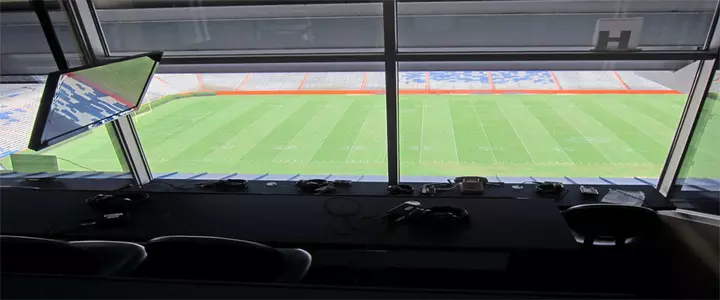
Gators running backs coach Brian White has often been that guy in the coaching booth upstairs trying to relay information down to the sideline. It might sound simple, but it could be a very tricky task considering the circumstances.
However, the job gets easier this season due to a new NCAA rule that allows coaches to have video monitors in their coaching booths. The coaches in the booth can watch a live broadcast of the game and when there is a questionable call, they can better determine if a replay challenge should be issued as the coaches on the field ask for their advice.
White welcomes the rule change, one that should help him stay in his seat more.
“Obviously this will be a lot more efficient and quicker,'' White said.
First-year Gators head coach Will Muschamp also favors the new rule and the extra confidence that comes with knowing the assistants upstairs have a clear replay to watch.
“I think it was really unfair until this season,'' Muschamp said. “You can win or lose a ballgame depending on the replay situation.
“And I really like college football as opposed to the NFL in that they will review a play. You don't have to ask for it. I think that's a tremendous advantage for everybody.''
In his first season, Muschamp will have White and defensive backs coach Travaris Robinson in the booth to relay information to the sideline. Offensive coordinator Charlie Weis and defensive coordinator Dan Quinn will be on the field.
“I feel like it's important to have Charlie on the field from the standpoint of the first year in the offense,'' Muschamp said. “In the first year – and I've been through it before – the growing pains of something happens on game day that you are not prepared for. So we've got to get them over, get them calmed down and got to say, 'this is what's happening.' And Charlie is going to do that best on offense and Dan is going to do that best on defense.''
In the SEC, the head coach retains a challenge if his initial challenge is successful and thus results in a reversal by the replay official.
The SEC has used instant replay since 2005 and coincidentally, one of Florida's more controversial plays involving instant replay came in 2006 when the Gators played at Auburn in Muschamp's first season as the Tigers' defensive coordinator.
With Auburn leading 18-17 and the Gators driving for the potential go-ahead score, Florida quarterback Chris Leak pump-faked a pass on third-and-3 from Auburn's 6-yard line. Leak then started his arm forward again and the ball came loose as he motioned forward.
Auburn's Tray Blackmon scooped up the loose ball in what turned into a 27-17 win for Auburn, the Gators' only defeat on the way to a national title. Leak motioned to officials that he was trying to pass. Florida coach Urban Meyer called a timeout to have the play thoroughly reviewed after officials took a quick look and ruled it a fumble.
The play on the field stood and the SEC later ruled the officials made the proper call with what video evidence they had to work with.
In a situation like what happened at Auburn, a video monitor upstairs could have helped calm some of the confusion on the sideline for the Gators and perhaps saved a timeout.
“I better be right when I give all the information to Coach Muschamp and Coach Weis,'' White said. “I'm sure it will be good and it will be great to be able to communicate what you will see up there in terms of decisions that will be made based on information we give from the booth.''
Meanwhile, here is a look at two other notable rule changes for the 2011 season:
--The NCAA has followed the NFL's lead by instituting a 10-second runoff for offensive infractions inside the final minute of either half. The rule is intended to prevent a situation like in last year's Music City Bowl when North Carolina beat Tennessee on a last-second field goal after time expired due to an offensive penalty that gave the Tar Heels extra life. Technically, the runoff isn't mandatory; if the defensive team is trailing, it has the option of declining both it and the penalty.
--A new taunting rule is in effect that makes unsportsmanlike-conduct penalties either live-ball or dead-ball fouls. Previously, all such fouls were treated as dead-ball penalties. According to NCAA.com, the following example is used: for example, if a player makes a taunting gesture to an opponent on the way to scoring a touchdown, the flag would nullify the score and penalize the offending team 15 yards from the spot of the foul. Penalties for dead-ball misconduct fouls (for example, unsportsmanlike behavior after the player crosses the goal line) continue to be assessed on the ensuing kickoff or the extra point/two point conversion attempt.