Carter: Trying to Replace the Irreplaceable is Never Easy
Friday, September 2, 2011 | Football, Scott Carter
GAINESVILLE, Fla. – This is a confession I probably would not make – at least not here – if Will Muschamp wasn't Florida's head coach.
But facts are on my side. After all, Muschamp once spent a Saturday night in The Swamp drilling Gators receiver Chris Doering in the ribs as a hard-hitting safety for the Georgia Bulldogs. That was 17 years ago.
With Muschamp now in orange and blue and ready to make his Gators debut on Saturday against Florida Atlantic, I figure it's safe now to say this aloud: I think former Georgia running back Herschel Walker is the greatest player in college football history.
Did I just feel an earthquake here in Gainesville? No, can't be. They more often happen in California. But I do see an army of Gator fans in No. 15 jerseys marching my way. Just one man's humble opinion.
Here's the backstory and why it's relevant to the Gators now: Walker ran onto the college football scene like a comet, becoming an icon before the term was tossed around like candy at a Christmas parade. Of course, my opinion is framed within the vantage point of a young boy living in East Tennessee in the fall of 1980.
My family lived about an hour from Neyland Stadium in Knoxville, where Walker made his collegiate debut by flattening future NFL safety Bill Bates on a touchdown run that helped Georgia come back from a 15-point deficit to win, 16-15.
I wasn't at the game, but I remember watching on TV as No. 34 in red and black ran over and around would-be tackles. I instantly moved him ahead of Batman on my list of favorite superheroes.
My grandparents lived near Atlanta at the time, so as we visited during the Christmas holidays that year, Walker and the Bulldogs were everywhere on TV and in the newspapers as they prepared to face Notre Dame in the Sugar Bowl.
The Bulldogs won and Herschel became more of a legend than he already was. I remember getting a Bulldogs toboggan as a gift and pretending to be Walker when I wore it.
The clich? “a man among boys'' never rang more true when it came to Walker in college. After his freshman season, Walker didn't disappoint over the next two seasons, rushing for 100 yards in every game as a sophomore and scoring 20 touchdowns, and then winning the Heisman as a junior.
And then Walker was gone, leaving after his junior season for the USFL.
In Georgia's first game after Herschel left Athens, Sports Illustrated sent a reporter to Sanford Stadium to document the aftermath. The headline to the story – Trying to Replace the Irreplaceable – is as true today as it was 28 years ago.
The unenviable task of trying to replace Walker at tailback was left up to four players – running backs Keith Montgomery, Barry Young, David McCluskey and Bertrand Jackson. As you have probably guessed by name recognition, none could run a football like Walker.
The Bulldogs turned into a defensive-minded team in 1983 and actually finished fourth in the final AP poll with a 10-1-1 record. But former Bulldogs coach Vince Dooley never had another player like Walker.
When Walker's autobiography “Breaking Free” was released in 2009 – revealing he suffered for years from multiple-personality disorder – Dooley had a classic quote.
“All I know is whatever personality he had when he had the football was the one I liked,'' Dooley said.
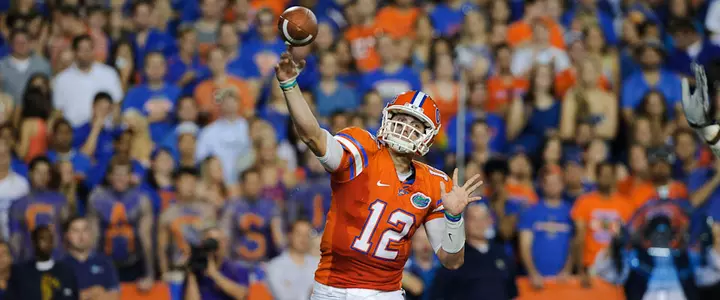
If anyone can relate to how Montgomery and Co. felt in 1983 and every Bulldogs running back since, Gators quarterback John Brantley is that person. Brantley “probably got the worst deal in college sports playing after Tim Tebow and in an offensive system clearly not designed to enhance his talent'' is the way an Orlando Sentinel writer described his 2010 season this week.
Like Walker, Tebow wasn't just a game-changing talent or national champion or Heisman Trophy winner, he became an iconic figure that transcended the game. Those just don't come around very often, which makes them even more difficult to forget.
Just ask those who must follow one.
In his first season as the starter, Brantley suffered some of the collateral damage that comes with trying to follow a polarizing player such as Tebow. Some of it could have been contained with more gaudy stats and a few more wins, but much of it was out of Brantley's control regardless of how he played.
A year later, with a new head coach (Muschamp), new offensive coordinator (Charlie Weis), new offense (bye-bye spread, hello pro-style) and new attitude, Brantley is hoping to get people talking more about the present than the past (i.e. Tebow-mania).
The Brantley-replacing-Tebow storyline was popular a year ago, but with Tebow now in Denver trying to prove himself in the NFL, Brantley and Tebow's current states are actually very similar.
While they don't talk on the phone as often as they used to, Brantley says he remains in close contact with his predecessor.
“We still talk here and there, but mainly by text though,'' he said this week. “We definitely keep in contact to make sure each other is doing all right.''
When asked about the common parallel they now share, Brantley said it's “kind of weird. But he's going to prevail and he's going to be very successful I think.''
Gator fans hope the same is true for Brantley. But the challenge of replacing an iconic player like Tebow is never one without unique challenges.
An icon remains an icon forever. Nearly 30 years after his final college game, Walker remains an omnipresent figure in Georgia and college football history. Earlier this year he even hinted at trying to come back and giving the NFL shot.
“I've told everyone that at 50 I might try football again to show people I can do that,'' Walker told ESPN. “I want to be the George Foreman of football, come back and do that one more time. I'm a much better-conditioned athlete now than when I was playing football. I'm [49] and in better shape now than I was when I was in my early 20s.''
The chances that Walker could return to the NFL seem about as likely as Gator fans forgetting about Tebow. Brantley knows they won't ever forget Tebow – and he doesn't want them to – he just hopes they remember him for more than the guy who had the task of replacing No. 15.
Through it all, what's the best advice Brantley has heard?
“What I've heard my whole life, and that's just keep your head up when things are going bad and when things are going good,'' Brantley said. “You've got to just keep your head up and keep moving forward.''
A look at some of the top icons (players only) in college football in the last 30 years and how their successors fared:
Tim Tebow, Florida (2006-09)
Tebow helped the Gators win a national title as a freshman, won the Heisman as a sophomore, led Florida to another national title in 2008 as the team's starting quarterback, and capped his career with a 13-1 record as a senior. Overall, the Gators were 36-5 in his three seasons as a starter. Brantley remains a work in progress entering his second season as the team's starter.
Herschel Walker, Georgia (1980-82)
Walker finished his career with more than 5,000 yards rushing and Georgia went 33-3 during his three seasons. He rushed for 1,752 his junior season, finally winning the Heisman after finishing third as a freshman and second as a sophomore. The year after Walker's early departure, Georgia's four primary running backs gained a total of 1,688 yards. The Bulldogs didn't have another All-SEC running back until 1986 when Lars Tate had a breakout season.
Bo Jackson, Auburn (1982-85)
Jackson's combination of speed and power reminded a lot of fans of Walker. He won the 1985 Heisman Trophy by rushing for a school-record 1,786 yards, which is saying something considering the number of great running backs who have played at Auburn over the years. His replacement, St. Cloud High product Brent Fullwood, rushed for 1,391 yards the season after Jackson left to continue Auburn's strong tradition at tailback.
Deion Sanders, Florida State (1986-88)
Few players in college football history have been as charismatic as Sanders, who won the Jim Thorpe Award as the nation's best defensive back in 1988. He was also an electric kick returner, leading the nation by averaging 15.2 yards per punt return. Adding to his colorful legacy, Sanders is known as “Neon Deion” and “Primetime.'' His emergence helped FSU land a pair of excellent replacements, cornerbacks LeRoy Butler and Terrell Buckley.
Peyton Manning, Tennessee (1994-97)
He is known around Gainesville as the guy who was never able to beat the Gators, going 0-4 in his college career. But in Knoxville, they named a street after him and nearly threw a riot when he did not win the Heisman his senior season. Manning's legacy remains vibrant today as one of the NFL's top quarterbacks. While his replacement at Tennessee – Tee Martin – didn't have much of an NFL career, he led the Vols to the 1998 national title during Manning's rookie season with the Colts.
Brian Bosworth, Oklahoma (1984-86)
An All-American linebacker and two-time Butkus Award winner, the outspoken Bosworth was known as much for his brash talk and colorful hairstyles as for his bone-crushing tackles. He parlayed his brazen persona into a movie career after his NFL career was cut short. The lasting image of his NFL career is perhaps getting run over by Jackson in a game between the Raiders and Seahawks. Soon after leaving Oklahoma, the program declined amid off-the-field troubles, many exposed with the help of a controversial book by Bosworth.
Those are the six players I consider the biggest college football icons (players only) since I first saw Walker.
I asked my Twitter followers for six more on Thursday and here are the players most commonly mentioned: Charles Woodson, DB (Michigan), Vince Young, QB (Texas), Doug Flutie, QB (Boston College), Raghib “Rocket” Ismail, WR (Notre Dame), Desmond Howard, WR (Michigan) and Reggie Bush, RB (Southern Cal).