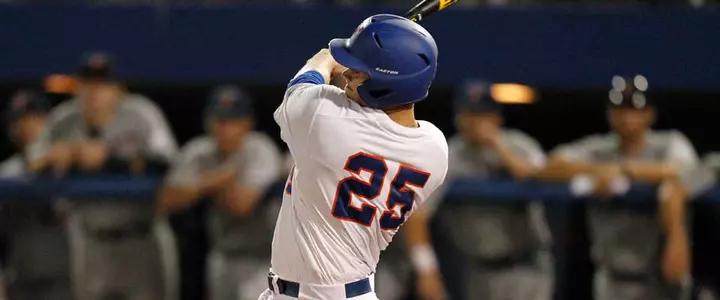
Gators Hit Machine Preston Tucker Talks Hitting as He Closes in on UF's Career Hits Record
Friday, May 11, 2012 | Baseball, Scott Carter
GAINESVILLE, Fla. – The irony isn't lost on Preston Tucker as he enters the final regular-season home series of his UF career.
Once upon a time Tucker's main focus was to get hitters out. He has spent the past four years trying to knock pitchers out – as in out of the game.
"In Little League I was always a better pitcher,'' Tucker said. "In middle school I was a better pitcher. In high school I only made varsity my freshman year because I pitched. I had an OK sophomore year.
"The summer after that things started to turn around."
In that "OK" sophomore season at Tampa's Plant High, Tucker batted over .400. His baseball future was sealed. Bye-bye pitcher's mound and hello batter's box.
When Gators coach Kevin O'Sullivan was hired before the 2008 season, Tucker's number was on speed dial.
"He was the first guy we kind of went after hard,'' O'Sullivan said.
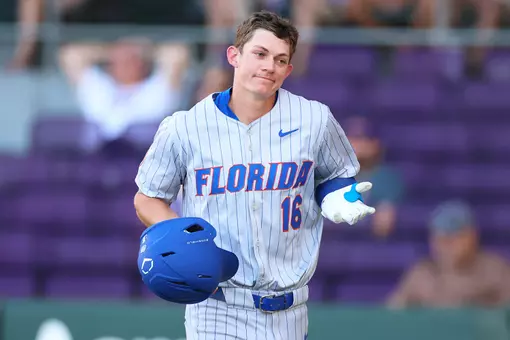
As Tucker's college career winds down, he has an opportunity to become Florida's all-time leader in career hits. Tucker enters this weekend's series against Mississippi State with 317 career hits, two shy of Mark Ellis' school record set from 1996-99.
One of Tucker's biggest hits – career hit No. 252 – came against the Bulldogs in Game 3 of last season's Gainesville Super Regional. Tucker stepped to the plate against Bulldogs closer Caleb Reed with the Gators trailing 6-4 in the seventh inning.
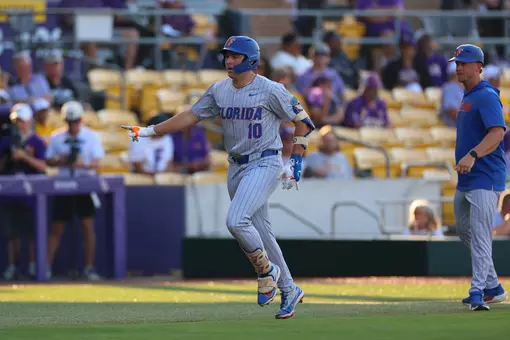
There were two runners on when Tucker let it rip. Seconds later his three-run homer sailed high over the center-field wall. An hour later the Gators celebrated another trip to Omaha.
Mr. Clutch, or Tuck as his teammates call him, had delivered again. His eight career postseason home runs are a school record.
"What he's done is not surprising," O'Sullivan said. "He could always hit. He loves to hit. That's what good hitters do. They love to hit."
Tucker is at it again this season, batting .317 with 12 home runs and 37 RBIs. He has more walks (27) than strikeouts (25), a sure sign of a hitter who steps to the plate with a plan.
With Tucker closing in the UF hits record, he talked about the path he took to get to this point.
A HITTER HE EMULATED WHEN YOUNGER
Tucker grew up during a time when home runs were flying off big-league bats at a dizzying pace. We know now that not all those home runs were simply a product of natural ability or water-downed pitching staffs.
However, Tucker's baseball idol – the player he pretended to be in the backyard as a kid – is perhaps the most naturally gifted player of his era.
"I tried to emulate Ken Griffey Jr.,'' Tucker said. "That didn't work too well. I don't hit anything like him."
At Plant, Tucker developed a reputation as one of the state's best prep hitters swinging away on Wade Boggs Field. Boggs attended Plant before he became one of the best hitters in the Majors during the 1980s and '90s.
Tucker once met the 2005 Baseball Hall of Fame inductee at a teammate's house. No surprise what they talked about.
"He talked to me a little about hitting,'' Tucker said. "It was nothing too serious, something a little light."
GREATEST INFLUENCE ON HIS HITTING APPROACH
While Tucker spent most of his youth expecting to be a pitcher, he did take occasional hitting lessons from private instructor Dennis Braun, who worked with numerous kids in the Tampa area.
As fate would have it, by the time Tucker joined the varsity at Plant, Braun was in his first season as the school's head coach.
Those hitting lessons took on a more serious tone as Tucker's future moved from the mound to the everyday lineup.
"In my junior year is when I started to realize I possibly had a future in baseball,'' said Tucker, a 16th-round selection by the Rockies in last year's MLB Draft. "He left me alone for the most part but he was a good coach to help me along with my swing. Once I got here, it was more about approach than about mechanics. You get here for a reason – because you can hit at the high school level – but once I got here all the coaches helped me out with more of an approach at the plate."
PRE AT-BAT ROUTINE
Baseball players are a superstitious bunch by nature. Tucker doesn't consider himself overly superstitious but he does try to maintain a few routines before stepping to the plate.
"You want to get comfortable in the on-deck circle," he said. "You are thinking about taking the same amount of swings, getting prepared, walking up to the plate and grabbing some chalk to keep my hands dry.
"There is nothing in particular I do every single time."
Tucker's approach at the plate does include one oddity: he doesn't wear batting gloves. Most players go through a pair of batting gloves every couple of weeks, but Tucker prefers to keep his hands in direct contact with the bat.
He has not worn gloves since his sophomore season at UF.
"I was in the Cape Cod League and I had been struggling for a while and got to messing around in BP, and one day I just didn't use gloves and I hit pretty well,'' he said. "I figured I would decide not to use gloves for the game I was playing in. I went on a roll from there and it kind of just took off."
HIS TYPICAL APPROACH AT THE PLATE
Some hitters are swinging at the first pitch before they ever step into the batter's box. Others hardly ever swing at the first pitch. Some look for an outside pitch to hit. Others consider their "hitting zone" on the inner part of the plate.
Tucker is selective by nature – his walks-to-strikeouts ratio proves that – but he also considers himself an aggressive hitter.
"Obviously there are different approaches in different situations, whether I'm leading off or hitting with guys on base,'' Tucker said. "It's basically getting a good pitch and finding a way to get on base."
Gators pitcher Hudson Randall is glad he doesn't have to face Tucker in games, but if he did, he wouldn't meet the challenge by nibbling the corners.
"I would just attack him,'' Randall said. "I would make him beat me on my best pitch. He's a good hitter and he's going to square a lot of stuff up that you throw in the zone, so maybe I'll try to get him chase a little bit."
THE BAT HE USES
Tucker has spent most of his career swinging an aluminum bat per high school and college baseball rules. He used wooden bats in the Cape Cod League, an adjustment he'll have to make once again as a professional.
As for the model, Tucker swings a version of the Easton S1 bat that is popular in the college game.
According to Easton's website, the S1 model was built with "bat speed and power" in mind. Tucker did make one change this season. He used a 33-inch, 30-ounce model a year ago; this season he is swinging a 34-inch, 31-ounce model.
"These swing a littler better,'' he said. "I choke up a little bit with these new ones. I think they have a better feel."
HIS APPROACH OFF THE FIELD
Tucker did plenty of homework the last four years to earn the undergraduate degree he accepted last week. Not all of it was for his classes.
Tucker spends a lot of time off the field studying film and learning as much as he can about the art of hitting.
"When I'm swinging the bat well, I don't watch film,'' he said. "I try to stay away from that and just try to feel comfortable at the plate. When I'm not swinging well I try to go back and look out at at-bats – maybe not from this year but last year or two years back – and try to pick out different things I'm doing."
When the Gators aren't playing, Tucker can often be found watching another college game or big-league game on TV with his teammates. He never strays far mentally from a bat and ball.
"It's pretty much all I talk about,'' he said. "Whether it's watching guys on TV or watching guys we're playing against or watching guys who are in the lineup with you. There is always something [to learn]. I'm always watching big-leaguers, their approach at the plate and how they are getting ready and how they are getting set up. I think it's really beneficial watching these big-league games and see how guys succeed at that level."
Gators catcher Mike Zunino can vouch for Tucker's love of hitting, watching hitting and talking about hitting.
"He puts a lot of thought in and watches the pitchers and tries to gather as much information as he can about the pitcher before his at-bats,'' Zunino said. "I've learned a good piece from him on that. He's just always soaking up information. That's helped me as a hitter."
HIS BIGGEST CHALLENGE
Hall of Famer Ted Williams once said hitting a baseball is the hardest thing to do in all of sports. Those who have tried hitting a 90-mph dancing ball tend to agree.
"It's extremely hard. The toughest thing about baseball is consistency,'' Tucker said. "It's so easy to go 4-for-4 one night and to have a 0-for-4 game the next day. The main thing is just to try to be consistent throughout the year. A lot of guys struggle with that and that's why they are not successful."
In Tucker's view, becoming a good hitter is a never-ending process.
"There are still parts of my swing I'm trying to adapt,'' he said. "My swing is always changing a little but for the most part the mechanics are pretty similar."
WHAT WOULD THE UF HIT RECORD MEAN?
Maybe Tucker will break Ellis' record on Friday. Maybe Saturday. Maybe Sunday. Barring an injury or slump like he's never known, Tucker will almost certainly become UF's all-time hits leader in the next few days.
His name is already splashed across the school record books. Still, any record is a good record considering the program's past.
"Having my name mentioned with some of the guys who have played here is – I mean, they are in the big leagues and have been playing for a long time – so it's obviously pretty cool being in the same category as those guys,'' Tucker said.