Using 'Bricks' to Build a Foundation for Accountability
Monday, December 8, 2014 | Men's Basketball, Chris Harry
GAINESVILLE, Fla. -- The term “brick” is a common one to basketball vernacular, with its connotation as self-explanatory as it is descriptive. Shots that clang hideously off the rim or bang uselessly off the backboard qualify as such.
But inside the walls of the Florida basketball complex, the word has been shouted by Coach Billy Donovan during the last week maybe more than at anytime in his 19 seasons; and not because the Gators have bounced field-goal attempts at a woeful mark of 39.5 percent and 3-pointers at a 30.3 clip this young season, both numbers abysmally below the norm for his past UF teams.
No, “brick” has taken on an altogether new -- and diabolical -- meaning in the Florida nomenclature, all by design, courtesy of the head coach, and with a goal of emphasizing a level of responsibility that is missing from this rebuilt 2014-15 team.
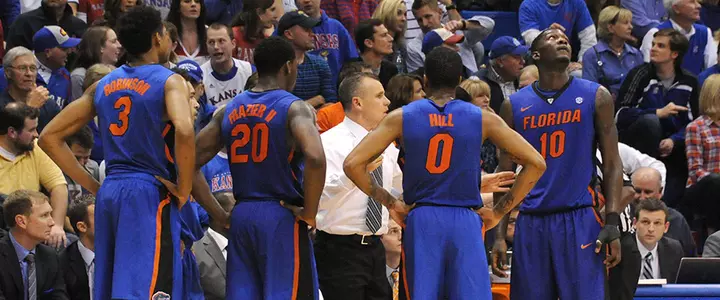
“As a coach, you always have to have accountability, as far as things they know they're supposed to do,” Donovan said. “But when you've talked to them and showed them and exhausted all those methods and opportunities, and they're still not getting it done ... well, there needs to be a different message; a different way to convey the message.”
You know what they say about desperate times and desperate measures, right?
So Donovan has reached back in the archives and gone to one of the Rick Pitino methods he was once introduced to as a player at Providence. It's a plus-and-minus evaluation indicator known as the “Bricks & Saves” system.
The right play. A good play. A hustle play. That's a “save” for that player on his chart.
The wrong play. A wrongly executed assignment. A missed opportunity for a hustle play. Well, that's a “brick,” which means extra conditioning, be it at points during practice or afterward.
Donovan and his staff rolled out the system in the wake of the team's performance in its three games at the Battle 4 Atlantis in the Bahamas -- a last-second loss to Georgetown, a narrow defeat of Alabama-Birmingham and wire-to-wire beatdown loss to North Carolina -- and it smacked the Gators upside their heads like, well, a ton of bricks. UF responded with a sensational first half Friday night at Kansas, only to revert back into some bad habits in the second, as the No. 11 Jayhawks stormed back from 18 down with 16-plus minutes to go and win fairly easily.
The Florida coaches used the game's final 17 minutes -- ugh! -- to assess their bricks and saves for practice Saturday, as the Gators (3-4) turned their attention to Monday night's home game against Yale (8-2), which stunned defending national champion Connecticut 45-44 on the road with a buzzer-beater Friday.
That meant pre-practice running, based on a player's brick-to-save differential. The chosen punishment was a drill where players had to make x-number of fullcourt layups in x-number of seconds; four in 22 seconds, five in 28 seconds or six in 35 seconds. Miss the required time, add a brick.
Last week, “burpies” were mixed in ... just for fun. Ten, maybe 15 or 20. If you don't know what a burpie is, go here.
“As a player, it's very, very easy to lose sight of the things that really go into winning and get consumed on what you want to to,” Donovan said. “Having a measuring stick, where there are pluses and minuses, helps them see things they're doing well to impact the team and also see the negative things that are hurting the team. At the end of the day, those negatives are put against the positives.”
Whatever the difference equals conditioning.
Pitino first implemented his bricks and saves ways at Boston University, only with a different implementation. He would have his players get in a defensive stance, palms open and balancing a brick in each. From that that position, they would do defensive slides. Lots of them. The tactics evolved when Pitino went to Providence, where Donovan recalled his mentor once assigned 185 brick sprints to a Friar teammate.
Eventually, the system made it to Kentucky. UF assistant John Pelphrey starred for the Wildcats and got his share of bricks along the way.
“He'd give 'em out like candy, five and six at a time,” Pelphrey recalled.
Donovan isn't doing that, and no Gator has been anywhere near that ungodly 185 number, but if you think running, say, 15 of those layup drills is easy, go try it. Or go do 10, 15 or 20 burpies.
“You get tired, but you push through it,” freshman forward Devin Robinson. “You don't really have a choice.”
And there's no appeal process, either. Donovan and his assistants are judge and jury.
“Lazy pass, Chris Chiozza! Brick!”
“Brick! Alex Murphy! Lost his man on defense!”
“Save, Chris Walker! Diving for a loose ball!”
“Save, Michael Frazier! Taking a charge!”
“Two bricks for the whole Blue team for not knowing what the hell they're doing!”
Every now and then, a player may glance a double-take when called out, maybe roll an eye, but they know better than to debate the ruling.
“A brick is whatever he says it is,” senior forward Jake Kurtz said. “It's never good and it means you're not doing your job.”
That's the whole point. As Donovan and his coaches have said over and over.
“You have a chance to do the right stuff or do this stuff. Why not just do your job?”
And do it for more than half. Preferably, starting against Yale.
Talk on defense. Execute pick-and-roll the right way. Offensive rebound. Take a charge. Be the first on the floor for a loose ball. Deflect a pass.
All these are things the Gators can control.
As opposed to the latest consequences.
“They need to take pride in their performance. It needs to mean something,” Donovan said. “They need to be responsible and accountable for that performance. We've tried to get that through to them other ways. Now we're trying this.”