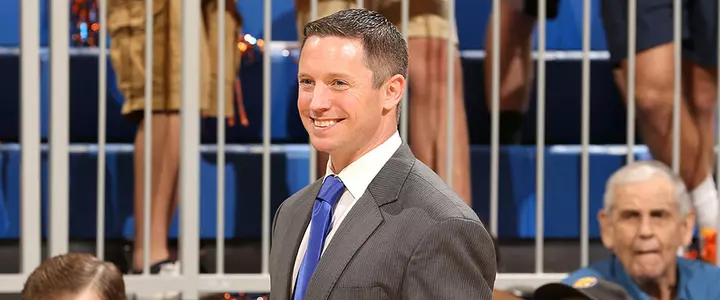
Mike White is All About the Fight
Friday, November 13, 2015 | Men's Basketball, Chris Harry
ANNAPOLIS, Md. -- The way his high school coach remembers it, Mike White was not just a poor defensive player.
He was awful.
The kid who carved a reputation as an in-your-shorts defensive gnat for four years in the Southeastern Conference, and now as a head coach rails at his University of Florida players about an uncompromising on-guard ferocity, was once utterly disinterested in playing that end of the floor. White doesn't deny it, either.
“He can't,” recalled Chris Jennings, still in charge of boys hoops at New Orleans Jesuit High. “He was really, really bad, and he knew it too because I was always reminding him how terrible he was. He didn't guard a soul. Ever. I'm still mad at him about it now.”
 Offense, though, was a different matter. White averaged 22.7 points per game as a senior, bagging 40 one night, 39 a couple others. He hit nearly 60 percent of his 3-pointers and 80-plus from the line, as well. He got a few feelers on the Division-I recruiting trail, but interest was mostly lukewarm for a 6-foot, 155-pounder.
When White signed with Ole Miss, he learned quickly that his greatest liability had to become his greatest asset if he had any hope of playing point guard in the SEC. In time, White not only evolved, he mastered the art of defense.
Later, during two stops as an assistant coach, he soaked up the finer points of working from the sidelines, applying what he learned as a big-time collegiate floor general and putting it to use with a clipboard. Again, he evolved and excelled.
At age 34, White got his first head-coaching job at Louisiana Tech and figured out quickly what it took and how to succeed at the mid-major level, winning 100-plus games over four seasons by finding fringe high-major prospects, mixing them with junior college transfers and unleashing them in a frantic, frenetic and fire-from-3 brand of ball that played magnificently to the fan base in Ruston, La. Under White, the Bulldogs were an aptly named bunch, given the mentality of their leader.
Now that bulldog is a Gator.
The flag of the Mike White era officially gets dropped Friday night when Florida takes on Navy in the second game of the Veterans Classic double-header at 9:30 p.m. The matchup with the Midshipmen carries a touch of irony, considering White was recruited back in the day by one of the service academies.
“Navy will be as disciplined, as tough and as accountable as any team we play all year,” White said. “They're soldiers.”
As a lifelong overachiever, White can appreciate a fight. That's a good thing because the challenge he walked into at Florida will be scrutinized by all the college basketball world. Whatever White learned in going 101-40 at Louisiana Tech -- plus 11 seasons as an assistant at Jacksonville State and Ole Miss -- pales against the seismic shifts the SEC undertook with Billy Donovan in his nearly two decades on the UF sideline.
When Donovan left for the NBA last spring, Florida Athletic Director Jeremy Foley locked in on White early and is confident the foundation laid by the legendary "Billy D" is set up for White to continue the Gators' success. The pressure in replacing an icon is immense. A solid, talented and deep squad only adds to that expectation. So who really knows how White will react?
His track record, though, suggests he'll evolve.
And succeed.
“He may have the face of an altar boy,” said father Kevin White, now the athletic director at Duke. “But he's the toughest SOB I know.”
The new face of Florida basketball is not like the old one; not even the boyish one of 19 years ago. Donovan was a Big East hot shot and shot-maker with Rick Pitino pedigree and persona.
Now the Gators are in the hands of a workmanlike SEC point guard who likes to say he averaged more fouls than points per game.
But he always led his team in substance.
“I actually see a lot of Billy Donovan in him and have thought that for several years now,” ESPN analyst Jay Bilas said of White. “And when I compare him to Billy, it doesn't mean he's exactly like Billy. Michael is his own man, but I think there are some similarities there that are really uplifting when you look at his potential as a coach. If Florida wanted to win the press conference, Michael may not be their guy. But if you want a longterm answer as a coach and a guy who's the real thing? I believe Florida got the real thing.”
![UF coach Mike White huddles with his team during the Gators' defeat of Palm Beach Atlantic in last week's exhibition game at the O'Connell Center. [Photo by Tim Casey]](http://www.gatorzone.com/gallery/photos/3340/015_WhiteMike_151105_8843_TimCasey.jpg)
SUNSHINE STATE ROOTS
White was born March 2, 1977 in Dunedin, Fla., the son of the boys track coach at New Port Richey Gulf High. That coach would soon embark on the road to sports administrative giant and take his five children -- Mike was second oldest -- on a military brat-like existence. The bases: Central Michigan, Morehead State, Southeast Missouri, Loras (Iowa) College, Maine, Tulane, Arizona State, Notre Dame and Duke. It was that Tulane stop, though, where young Mike decided on his sport of choice.
 To that point, he'd tried football, baseball, soccer, swimming, track and even gymnastics. His mother, Jane, was also a coach. And from Michigan. So Mike adopted an affinity for the Wolverines (as in Rumeal Robinson) and Spartans (as in Steve Smith) and after playing backup quarterback on the Jesuit freshman football team and being cut from the basketball team as a freshman, White decided he wasn't good enough to play both.
“From there, I actually lived in the gym,” White said. “I kind of had a built-in excuse, being at an all-boys school in the city. Plus, I was a pretty shy kid, so it wasn't like I was out trying to meet people.”
So he shot. And shot. Then shot some more.
As a sophomore, White made the varsity team, but played “mostly scrub minutes,” because he could not defend. By the time White was a junior, he was the team's best scorer and only got better.
“He always had the latest gimmick technology,” Jennings said. “If there was a strength shoe or weighted vest, whatever it was that kids thought would make them better, he had it.”
Jennings oftentimes would come in to the gym and see White working out by himself.
“But there was never any reason to think he would be an SEC player,” Jennings said. “When you have an SEC player, you know it.”
LSU, an hour away, made a courtesy call, but wasn't interested. Marquette paid Jesuit a visit. So did Army. Rick Majerus came from Utah. Tulane, just across town, was never an option. White didn't want to go where his father was athletic director.
It was a happenstance stop by an Ole Miss assistant, who came through to watch some Catholic League games, that got the Rebels on the trail. Word filtered back to Coach Rob Evans that Jesuit had a kid he needed to see. Evans came to New Orleans, watched White play, did an in-home visit and offered him a scholarship.
 One of his first days on campus in the fall of 1995, White walked past Evans' office after a few games of pick-up. College was different than back at Jesuit for the little guard. White was frustrated and some of his new teammates had brought that exasperation out of him on the floor.
Evans called White into his office.
“They don't like you very much, do they?”
“No, they don't.”
“That's OK, Michael. They'll love you before it's all over with.”
The Rebels didn't like White because he was feisty, fought back and even barked at them if he felt the need. He wasn't going to overpower or out-jump anyone, so it didn't take White long to realize toughness was going to determine how much he played.
“He was unselfish and all about winning,” Evans said. “And he expected everyone else to be like that, too.”
So over the next four seasons, White started 109 of 117 games, averaged 5.1 points, 1.9 rebounds, 1.6 assists and shot 40 percent from the floor and 36 percent from the 3-point line. Hardly eye-opening numbers.
Yet the Rebels, with just one NCAA Tournament berth in their history, went 74-44 over that time, won the SEC West twice and reached the NCAAs three times.
As a senior, White played with a broken nose (which he never fixed), a broken finger, a rotator cuff tear and sprained ankle -- all at once. He willed himself onto the floor and played until his body just would not let him play anymore.
 The Rebels fed off their undersized leader's tenacity and resolve.
“He was never afraid to challenge his teammates and he was never afraid of a challenge on the floor,” Evans said. “Michael had a little bit of an edge to him. A little bit of a temper. In fact, I had to take him out of couple games to calm him down.”
In '99, Ole Miss and defending national champion Kentucky were playing in the SEC Tournament. White had three fouls in the first half, got a quick one in the second, and when sent back on the floor got his fifth almost immediately while trying to defend lightning-fast Wildcat Wayne Turner.
White did not like the call, told the official so and after getting hit with a technical foul slammed the ball to the floor. It caromed high into the air and dropped into the lap of play-by-play broadcaster Tim Brando on the sideline.
“Yeah, we still talk about that,” White said.
Others do, too. But in the bigger picture.
“Where some see temper, I see passion,” said Rebels teammate Keith Carter, one of White's closest friends and a fundraiser at Ole Miss who recalled that very same anecdote to paint a picture of White the competitor. “It was the passion that made Mike the player he was and it's the passion that's made him the coach he is. He's learned to control his demeanor, you can see that much. But that passion is still there.”
A COACHING CAREER CALLS
After finishing at Ole Miss, White played a month with the Utah Jazz summer league team and had a cup of coffee in both the International Basketball League and a pro league in England. During one summer in college, he had dabbled with a shadow internship on Wall Street, but White knew that wasn't for him.
“He just did not want to give up basketball. He loved it, but he also wondered how much he could take it because he hated losing so much. That actually scared him,” White's mother said. “But I told him I thought that would make him a better coach; that he'd fight harder to win.”
In 2000, White got a call from Mike LaPlante, who had played at Maine years before when Kevin White was AD there and little Michael was a ballboy. LaPlante had left his assistant's post at Auburn to become head coach at Jacksonville (Ala.) State, replacing Mark Turgeon. White was offered a full-time assistant's job and jumped at it.
The program struggled, with back-to-back losing seasons. Those fears White talked to his mother about were coming to fruition.
“The first few years were tough, really taxing -- and I gained about 35 pounds,” he said. “We were struggling with the same kids Turgeon won with. I didn't know what to think, so I just kept working my [tail] off.”
Then came a 20-10 record, followed by a phone call from his alma mater.
Rod Barnes, who'd played at Ole Miss, coached White as an assistant and was promoted to head coach after Evans went to Arizona State, brought White home to coach in 2004.
 White married his college sweetheart, Rebels volleyball player Kira Zschau (right), that summer and dove into life as an SEC coach. Everything was great -- until Barnes and his staff were fired in 2006 after two straight losing seasons.
The Rebels AD at the time, Pete Boone, tabbed White as "interim" head coach, charging him with keeping the program afloat until a replacement was found.
“They figured I was a company guy who loved the program and would do whatever I could to hold it together,” White said.
He managed to do so between phone calls to prospective employers. He needed a job. Ole Miss eventually settled on Andy Kennedy, by way of Cincinnati, as its head coach. Kennedy interviewed White and opted to keep him on as part of the new staff.
Alongside Kennedy, White coached four teams that won at least 20 games the next five seasons and played in the NIT three times, twice reaching the semifinals in New York. In 2009, White was named a finalist for the Coaches Award honoring the top assistant in the country.
“I had confidence in myself, but I also probably realized I wasn't fully prepared to be a head coach,” White said. “I don't think you can be until you actually go through it.”
Meanwhile, down in Ruston, La., Bulldogs AD Bruce Van De Velde had his radar on. The LA Tech program was struggling under Kerry Rupp and decided to make a change. In his hunt for a new coach, Van De Velde had to be realistic as far as where his search would land. His was a mid-major program that had one winning season in four under Rupp. He went looking for someone familiar with the region and with built-in recruiting inroads; someone who could relate to the area; someone who would embrace the community.
The search ended up with a young SEC assistant in Oxford, Miss., who had never coached in an NCAA Tournament game.
STUNNING TURNAROUND
In Rupp's final game before his firing at LA Tech, the Bulldogs were bombarded 70-30 by Utah State to finish the 2010-11 season at 12-20 overall and 2-14 in the Western Athletic Conference. The program graduated a guy who got 16 of those points. The team's best returning player transferred to Oregon.
Welcome, Coach White.
“In preseason, we were picked to finish eighth out of eight and would have been picked 60th out of 60,” White said. “We were terrible.”
Yet, the Bulldogs went 18-16 in White's first season, upsetting that same Utah State program to reach the WAC Tournament championship game.
“That whole season was like a blur to me,” White said. “I barely remember what happened ... and we had four babies in the house.”
Speaking of blurs, in his four seasons at LA Tech, the Bulldogs averaged 74.2 points, 7.3 made 3-pointers, 14 assists, 8.4 steals and 16.1 turnovers forced. His best player, point guard Kenneth “Speedy” Smith out of St. Petersburg, Fla. totaled 858 assists during that time, the most in the country by a player over those four years.
White's hard and fast style of play was uncompromising and a nightmare for opponents; and not just in the WAC (his first two years) and Conference USA (the last two). Wrapped in that .716 winning percentage were wins over Florida State, Georgia, Oklahoma, Oklahoma State and Texas A&M, three regular-season WAC championships, not to mention feelers from Tennessee, Missouri and Wake Forest (all of which White declined).
But no tournament titles.

Despite reguar seasons of 26, 27 and 25 victories, LA Tech suffered from the conference's low ratings percentage index. An at-large berth for the Bulldogs was going to next-to-impossible. The WAC and C-USA were basically one-bid leagues and those bids were the automatic ones that went to the champions of the conference tournaments; the tournaments the Bulldogs never won.
“It was frustrating,” White said. “We were always one of those bubble teams that got left out.”
LA Tech's 2014-15 season ended with a loss at Temple in the quarterfinals of the NIT on March 25. A month later, the college basketball landscape was rocked when Donovan left to become head coach of the Oklahoma City Thunder. That was a Thursday.
On Monday, the same day Donovan held an emotional morning news conference in Gainesville, White got a call in the afternoon. Foley and executive associate AD Mike Hill had spent the weekend crunching names and numbers and knew where they wanted to start.
Foley wanted to bring his search party to White's home in Louisiana.
“I have to warn you, we've got five kids,” White said of his brood, all under the age of eight. “If you don't mind dealing with throw-up and apple sauce ... .”
Two days later (amid the throw-up and the apple sauce), White agreed to a six-year, $12 million contract.
“I don't know that he would have left for any place else,” said wife Kira, two years behind White at Ole Miss but (ironically) also from Dunedin. “He knows coming to Florida, taking over for Billy Donovan, is a very tall task. He's always been driven, he's always worked hard, but I've seen him even more motivated since we've been here. I didn't think that was possible.”

NEW ERA BEGINS
Now seven months on the job, White has worked feverishly to maintain the expectation level that Donovan left behind. His practices are brutal. Not that Donovan's weren't, but there's definitely more running. Way more. Players who turn the ball over owe a down-and-back sprint. At the end of periods, the losing team runs; sometimes “22s” (two down-and-backs in 22 seconds), sometimes “44s” (four down-and-backs in 44 seconds).
The White system figures to be more up-tempo than the the last one. Donovan's teams still pressed quite a bit, but were at their best the last several seasons in pick-and-roll and pick-and-pop actions, the very kind the NBA came chasing Donovan for.
 “The practices and the pace are much faster,” senior forward Dorian Finney-Smith said. “When Coach D left they told me they were going to bring in a great coach. Coach White is a great coach. He's going to help me with my dreams.”
Sophomore forward Devin Robinson: “He's a young Billy D. They both want to win, both are passionate about the game, both demand that you compete and play hard on both ends.”
That includes defense. UF's new coach once committed himself to play it when he got to college and now demands the same from his players.
White, the player, evolved. Then excelled in his role.
In getting to this point, the coach version has done the same.
“He was smart about it,” Jennings said. “He could have jumped at a couple jobs, but he waited for the right one. He'll have that team playing his way and playing hard, I promise you that. I just think Florida seems like a great school, a great fit for him.”
And a very, very long way from awful.