Near extinction, longball in college game gets new life thanks to new baseball
Monday, February 16, 2015 | Baseball, Scott Carter

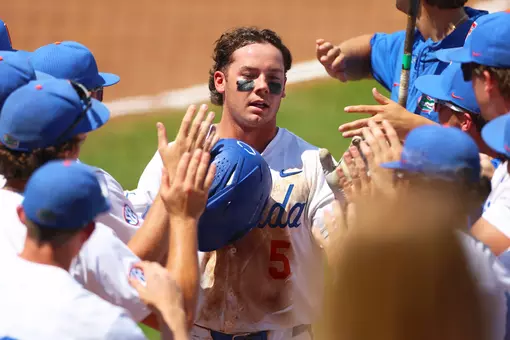
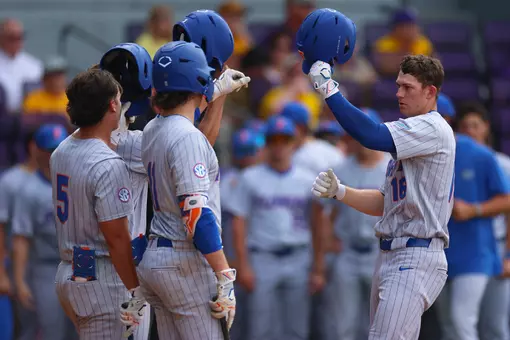
Ryan Larson connects for one of Florida's six home runs in sweep of Rhode Island. (Photo: Tim Casey)
GAINESVILLE, Fla. – A recent headline in Baseball America magazine asked: Can new baseball revive longball?
The question headlined a story about the flat-seamed baseballs the NCAA approved to be used in competition this season. According to Baseball America, in testing done by the NCAA, flat-seam balls thrown at the same speed and struck with the same bat speed travel 15-20 feet farther than the raised-seam balls the NCAA had been using.
If the first weekend of the season is an accurate sample, the answer is a resounding “YES.”
The Gators can attest to that.
In a three-game sweep of Rhode Island to open the season, Florida scored 37 runs and hit six home runs. A year ago the Gators hit 26 home runs all season and didn't connect for their sixth longball until the 21st game.
“I think the ball maybe has something to do with it,” Florida coach Kevin O'Sullivan told reporters Saturday after a 22-3 rout in which the Gators hit four three-run homers. “I think you're going to see as the season goes on that there's going to be more offensive production. I didn't know how much the ball was going to change it, but I knew it was going to change it some. Maybe it's going to be a little more than we thought.”
Barry Allen, a longtime college baseball chronicler and a statistician and researcher for FOX Sports and ESPN, posted a tweet late Sunday night that garnered attention on social media.
According to Allen, in 41 games involving Southeastern Conference teams on the first weekend of the 2014 season, there were 21 home runs hit and an average of 6.6 runs per game. In 43 games to start the 2015 season, there were 34 home runs and 9.1 runs per game.
That's a game-changer for a college game that had turned 180 degrees from the gorilla ball era of the 1990s that routinely featured 16-14 slugfests that more resembled softball contests in your uncle Chuck's Tuesday night beer league.
The introduction of the new BBCOR (Batted-Ball Coefficient of Restitution) bat in 2011 to improve player safety – the bats are designed to play more like wood bats – had a damaging effect on home runs. In records dating to 1970, teams averaged a record-low 0.39 home runs per game last season.
The Gators, after clubbing 75 home runs in 2012, only hit a combined 54 over the next two seasons. Part of that was a drop-off in offensive firepower, but the combination of the BBCOR bat and raised-seam ball certainly played a role.
The lack of power dampened some of the excitement around the game, including at spacious TD Ameritrade Park, which opened in 2011 and is home to the College World Series. In 29 games at the CWS over the past two seasons, only six home runs were hit – or the same number Florida hit in three games over the weekend.
A look around the SEC scoreboard this weekend revealed that McKethan Stadium wasn't the only place balls were flying out of the park.
While the flat-seam ball used in college isn't wound as tightly as the ones used in professional baseball, it has closed the gap between what college players once used and later had to adapt to in the minor leagues.
So what does the first weekend of the season mean? No one can say for sure this early, but the new flat-seam ball seems to have added hope back into the life of the longball, which appeared on the verge of extinction the past few seasons.