Billy Donovan Press Conference Quotes
Monday, February 9, 2015 | Men's Basketball
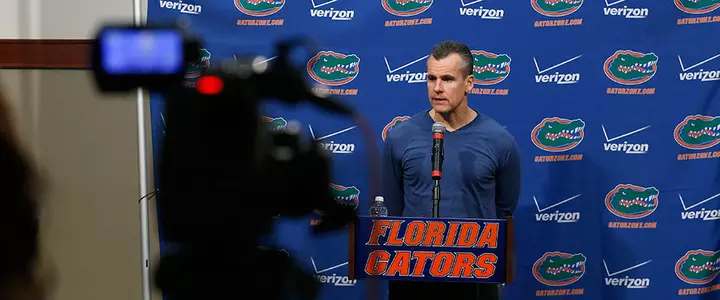
Head coach Billy Donovan gave his weekly press conference Monday morning and provided a status update on Michael Frazier II, discussed Saturday's loss vs. Kentucky and talked about Thursday's meeting with Ole Miss.
On the status of Michael Frazier…
I would say out right now. It looks like a high-ankle sprain right now. It is really hard with these things because there is not a lot of swelling in a high-ankle sprain. It is less than 48 hours from the game, but my feeling right now is he will be out. He is in a boot right now. How severe or how bad it is, we are really not quite sure yet, other than to say when we met with the trainer and doctor and it was really tender and all indications pointed towards a high-ankle sprain. It could be a couple days, it could be three days, it could be a week. We don't know until we see how he responds to treatment. Right now, he is not practicing today and I would say he is probably definitely out Thursday.
On how the loss of Michael Frazier affects the team…
We had to play the whole second half without him on Saturday. I thought our guys competed well. Again, it's not one guy that is going to have to make up for a player like Michael [Frazier]. It will have to be several guys to contribute and help. Hopefully guys like Devin Robinson and [Chris] Chiozza will have more of an opportunity on the perimeter than they had previously because Michael is not playing.
On what Ole Miss displayed offensively in the earlier game this season…
They are terrific offensively. The interesting thing in the [previous] game was our leading scorer had an unbelievable game, scoring 27 points. Their leading scorer, [Stefan] Moody, went 2-of-10 from the field, I think, and didn't have a great offensive game and we still came up short. I think a lot had to do with [Jarvis] Summers, like you mentioned. I thought Summers was physical and the kind of adjustments we will have to make with him you can. The thing with Summers that I have always admired and respected is that I think great players make people around them better. So you can try to take Summers out offensively by trying to trap him and do those things, but at the end of the day between Snoop [LaDarius] White and Moody and a lot of the other guys that they have in the front court, it's leaving those guys open, and that is why they are a balanced, well-scoring team.
On how your team competed on Saturday…
I thought that during the game and sitting on the bench that we competed really hard and we played really hard. I think that they knew that playing together was the only way to give ourselves a chance to win in the game. I thought we did that. They have a great opportunity to learn from what happened in the game. The thing that has been kind of amazing to me this year is Kentucky is clearly one of the better defensive teams in the country this year, if not the best defensive team in the country. I thought our ball movement and player movement was really good. I think this may have only been the second or third time all year where we had four guys in double-figure scoring. So the immaturity, the understanding of what really goes into winning, being able to play together and benefit off of playing together and making each other better are some things they can learn from. The biggest question I have and have always felt, which will be interesting to see, is are we an externally motivated team? When you are an externally motivated team that is a problem because you have to be internally motivated and inspired by yourself. It can't be me every game giving some rah-rah speech or who we are playing against, or if we are on TV. As a competitor it is really, really dangerous when you are dealing with guys who are externally motivated by different things. So how do we come back and respond from Saturday to this next game? I thought on Tuesday that Vanderbilt played well and out-worked us, out-hustled us, but from a perspective as a coach we did not play well at all. So, how do we go from one of worst performances on Tuesday to one of our best performances on Saturday? Why is that? That is going to be interesting, going forward, to see what those reasons really are. I have my thoughts, reasons and opinions on it, but some of that stuff I think will play itself out.
On if the way his freshmen played on Saturday is a microcosm of their season…
I thought [Chris] Chiozza gave us some really good minutes. I thought it was a tough game for Devin [Robinson]. He had three turnovers in six minutes, and then he gave up a three-point play on the dunk to [Willie Cauley-Stein]. I thought the back-to-back turnovers kind of allowed [Kentucky] to get a little bit of breathing room. It is interesting because when you are dealing with freshmen, those turnovers I see every day in practice and try to get [Robinson] to understand that those plays are momentum changing plays. It isn't in practice, but [I] am trying to get him to see that there is an area where he can learn from that in that situation. I thought [Robinson] came out aggressive and made a really, really good move to the rim and he finished and blew his sneaker out, so I had to get him off the floor. Then in the second half he had a couple of those turnovers that were costly and hurt. But, there were a number of [other] plays in the game that impacted the outcome. Give Kentucky credit, they went to the free throw line and they go 21-of-22. We go 7-of-14. Jon [Horford] had a couple of layups there in and around the basket. Eli Carter goes 1-for-8 from behind the three. There were some plays and things that we needed to do. I thought Chiozza had a pretty good look from the three-point line on some good movement that didn't go down, it went in and out. In games like that, you have to make some plays and make some shots, and to Kentucky's credit, they made their plays from the free throw line, which ultimately I thought was the difference in the game.
On why UF decided to drive into the lane a lot against Kentucky…
Well, I think with the way they [Kentucky] play, [Willie] Cauley-Stein is one of those rare guys in the country that can play five different positions. You know, I think what happened was that some of our struggles against Vanderbilt with getting seven shots blocked in the first half was our spacing issues. Our spacing was not good. We spaced them [Kentucky] a little bit better from the standpoint of when a big guy switched onto one of our guards when our guards are behind the three-point line and some of the time we got both of their bigs beyond the three-point line. So a lot of times when we were driving the ball to the basket we were not necessarily going against shot-blocking. Where we had poor spacing against Damien Jones and he was standing right at the rim there [against Vanderbilt]. [In that game] we had our front court guys in the wrong areas and standing in the wrong spots. And I thought that that was something that we cleaned up coming from that game into this game [Kentucky]. With Kentucky's shot-blocking ability, we were kind of able to move the floor a little bit and create some driving lanes. It's always really, really hard for shot-blockers against guards to block shots when guards are coming at them. It's a lot easier for a shot-blocker to come off the ball and leave his man to come over and alter and adjust shots. I think with the way we tried to play, we knew we were going to have to have; you know, there is a lot of people that think when you play against Kentucky, you have to bomb a lot and make a lot of threes. I've never believed that. I think that plays into their hands, because what happens is you're having to shoot over great length and you're having to shoot over great size. And a lot of times that leads to long rebounds and that leads to run outs for those guys and they're great in transition. If you've got stuff coming at the basket a little bit, there is a little bit more of an opportunity to get back in transition, there is a little bit more of an opportunity to score. You know, in the game [regarding] points in the paint with their size, we outscored them in the points in the paint. A lot of that had to do with our guards and our ability to drive the ball some and I thought we had the proper and correct spacing. And another thing too, unlike the Vanderbilt game, I thought our ball movement was really good. The ball didn't stick, the ball kept moving. And we got them caught into some binds where they had their bigs closing out to our guards which enabled us to drive the ball some.
On whether he thought his team would play with great energy against Kentucky…
I mean heck, if you can't get excited to play in a game like that then you've got some serious issues. Just calling it like it is. I would hope that we would be ready to play. That's my thing about being externally motivated. You know? How can you come out Tuesday that way [against Vanderbilt] and Saturday [against Kentucky] the next? The more I'm around these guys, and I'll just say it like it is. The more I'm around them, they as a group, they've got to be more internally driven and competitive than they are internally. That's been somewhat of a challenge for this group. You know, it's been the competiveness of, if you draw a line down a sheet of paper and you put on one side 'performance' and you put on the other side 'compete'. When you're wrapped up in your performance and how it's going for you because you're wanting to play well, you never, ever compete like you need to. When you just go out and compete, you're never, ever worried about your performance. You're just in the game competing trying to do your job and that's been the up and downs, I think, with this team. It's been that internal fortitude or fight or motivated or excited to play all the time, and I am trying to change mental disposition and habits that these guys have had their whole entire lives. And these experiences are hopefully changing their mental approach toward competing. I feel like that's my number one job for them to be successful. Even when they leave here, you know, because they're going to go get a job somewhere and you better be internally motivated to do your job. They've got to develop that piece of it there.
For example, for a guy like Chris Walker who is a very talented and gifted player, but he's never had to work for anything. But all of the sudden, you get to the point where your talent level just plateaus out and you know what? He's lining up against [Kentucky's Willie] Cauley-Stein, Dakari Johnson and Marcus Lee and you know what? They're just as good if not better. You've got to be able to hang your hat on something. So trying to get him to see the importance of really having to compete like he needs to. And I would say this using him as an example, Joakim Noah that was his greatest strength. He was an unbelievable competitor. Now his freshman year, a lot of times he didn't know where he was going or what he was doing, but you never had to worry about his motor and his energy and the way he was going to compete and battle and as time went on he learned those other things. It's a little bit reverse with this team. This team needs to learn how to really, really compete and what goes into competing and how to go about doing it. So I'm having to change in a lot of ways, the way these guys have played the game and the way these guys have been and it's been okay in high school and in AAU until this point. But it's not going to make them really good players at this level unless they change that mentality and that's really what my whole focus is on. It's not a schematic problem. I know that we've got some deficiencies in terms of we can't throw the ball into the post. You know, I know that we have been an erratic-streaky three-point shooting team at times. But, we did shoot 49% against one of the better teams in the country [Kentucky] defensively. We did do some good things offensively. We're capable but they've got to change that approach. There are games where the game sometimes is bigger than yourself and that was a game that was bigger than them. You know? I'm not so sure that there has been games this year that they haven't thought at times that they are bigger than the game.
On whether he is yelling at this team more than he has with past teams…
There is a little bit of everything going on. There is a little bit of everything going on. You try to put them in practice in these competitive situations. It's like I call timeout and there is 52 seconds to go in the game and Jon [Horford] had maybe turned the ball over, Horford did inside of a minute, I think it may have been a two-point game or maybe it was a two-point game they [Kentucky] made free throws. Whatever it was, we were coming back, I think it was a five-point game at that time and it's just like this look of just like, you know. And it's like, there is 52 seconds to go in the game. We've got to press right now. Can we get focused on competing right now on this play in this possession? That's what needs to happen. Like, that's what I'm talking about. If you're a competitive person, you don't get deflated so easy. Personally, they get deflated and that's where they've got to get better. So trying to get them to fight, trying to get them to compete, trying to get them to battle and do those things is the tough part. In all of us as people, there is an innate high-level of selfishness on our team. And I don't mean it like this, and I've said this before, I want to score 30 points and if I don't score. Or hey, I'm not shooting enough. It's not that. It's, they want to play well and when they're not playing it drains them. They're not internally fighting and competing to play to win. As a coach, you're trying to get them to understand that at this level, if you don't have that [then] it's really, really hard to win. It's really, really hard to. The other teams practice too and the other teams are prepared and the other teams are good.
On coaching a team that's struggling when there's been great success for the program in the recent past…
Well it's draining sometimes. It is. I try to, and I've said this before, you know, I think coming out of '07, starting over with the younger guys and being where we were, now you have this incredible team, and then you go back to what we had to deal with, with those guys. And then last year, this incredible team, you have to go back with what you're dealing with, with these guys. I think I've learned from eight years ago maybe for myself personally what's a better approach, and this is different from the perspective that these guys are going to leave here and they're going to go on into the real world. The thing that I would regret or hate as a coach is to say, you know, 'why didn't you tell me those things? Why did I not know those things?' This is a lot bigger for me as a coach than just these guys winning or losing a game. I get you guys are covering us right now and you're covering we win, we lose, we play good, we play poorly, whatever, I get that. But for me, I'm dealing with these guys every single day and there is a personal investment I have in them to teach them what goes into being successful, what goes into bringing value. When these guys leave here, wherever they go next, they have to be able to bring value somewhere. And I think in a lot of ways, I use Chandler [Parsons] as an example, he was like that as a freshman, but I think he's at where he's at in his career and in his life because of the experiences he went through. And now, you know what, maybe he can help some young rookie or guy have a better perspective so to me it's not so much, I mean, we all want to win, I want that, but I've got twelve human beings in there right now that don't have it all figured out and really need help. They really need help. And this is not a group that's belligerent, uncoachable, they've just got this disposition about them that's a “woes-y me,” when it doesn't go their way there's not a lot of fight. And I've got to help them see that's not the way the world operates. That's not the way the world operates. You have that attitude, there's no problem with someone writing them a pink slip and telling them to go find a job somewhere else. So I've got to help them in terms of the bigger perspective in life. And I think a lot of great lessons these kids can learn through competing and being a part of a team because they're going to be a part of a team the rest of your life, whether they get married, whether they work on the job, whether they go to church somewhere, they're going to be part of a team and they've got to learn how to bring value. And my question to them every day is who on this team…are the players that they're playing with better off because you're on the team? Who makes somebody else better? And I think really great people bring value somewhere and they've got to learn how to bring value in terms of their skill set, their strengths and their talents. And it's always going to be about them, how it's going for them. You can never get out of yourself and help somebody else. I think that's the greatest lesson these guys can learn through going through this experience right now.
On building a foundation this year for next season…
I think that there's things. I've said this before I don't think because of what they're going through right now that all of a sudden when they're a year older they're a year better I've never believed that. Their approach and their mentality has to change. Has to change for them to be as good as they feel like they're capable of being right now. It has to change. And, you know, for some guys, like I've said before, it takes a year, other guys it takes a little bit longer, but it needs to change, you know. I'll tell you a guy who was kind of like that early in his career was Casey Prather. He was kind of a “woes-y me” kind of a guy. He'll get down and disappointed when he didn't play well and then you know what, he developed into a really, really good player because he had to get hardened, he had to get tougher, he had to learn how to fight. And our guys need to get hardened and tougher and they need to know how to fight. And it's not easy. And I don't want the road for these guys to be easy because life's not going to easy. They better learn how to deal with that right now.
On Dorian Finney-Smith in particular showing signs of progress in not getting down on himself…
That's what it is. That's what it is, Kevin. It's not like…it's them being hard on themselves. It's them being disappointed in themselves. It's them feeling they're letting themselves down, people around them down, me down, the team. It's that kind of mentality. And Dorian [Finney-Smith]'s got it as worse as anybody, you know. And I had a conversation with Kasey Hill about this. Are you playing the game because you love them game, you want to be a great player, or are you playing the game for everyone else, to make everybody feel good about you? And that's a total shift and a mindset change for those guys. The one thing I'll say about those guys is they do care what the coaches and their teammates think about them. And when they don't do well, they feel like they're letting down the world and that's just not true. But that's what they're experiencing and they're feeling. I've got to help them play the game to get enjoyment out of it for themselves and learn something from this for themselves.
On whether or not he wishes he had a more physical guy on the floor with the departure of Damontre Harris…
Yeah, I mean of course you do, but I mean, who is that person? That's what you've got to look at. We'd all like to have, I think, a different kind of options, so to speak, but it wasn't from a lack of trying or working or those kind of things. We really felt like the Damontre [Harris] situation didn't work out, but you know, if you look at our team right now, with what we could see, theoretically you could have across the front line right now a Damontre Harris, Chris Walker and Jon Horford. That's three pretty vulnerable guys with some size and some length. But that stuff didn't work out, so it wasn't like we just have nobody in the program, we were just empty. Sometimes those things don't pan out and you get caught. I remember the same thing happened in '06 and '07. We were as slim as possible in the back court with Taurean Green and Lee Humphrey. The only other guard we had coming off the bench was Walter Hodge that year. So you're always trying to field 13 scholarships but sometimes different things happen and situations happen that are kind of out of your control.