
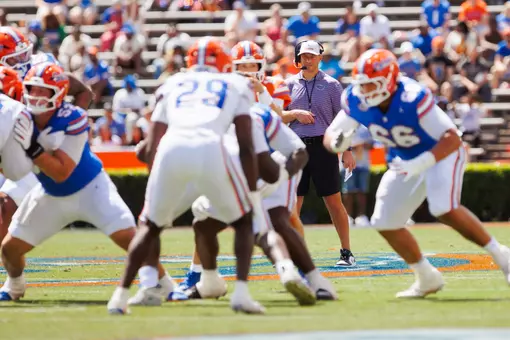
The first game at the newly christened Steve Spurrier-Florida Field at Ben Hill Griffin Stadium will be the 2016 season opener Sept. 3 against UMass.
Harry Fodder - What's In a (SEC Stadium's) Name?
Friday, June 10, 2016 | Football, Chris Harry
What the rest of college football's best league calls its stadiums
 GAINESVILLE, Fla. — The historic announcement Thursday that Steve Spurrier's name would share the marquee with Florida Field, in the really big picture, was not a surprise.
 More like an eventuality.
Putting the name of the most famous figures in a program's lore is a practice employed by athletic departments around the country. In fact, in the Southeastern Conference alone, only LSU's Tiger Stadium — often referred to as "Death Valley" — is the lone football cathedral that doesn't have a namesake. Several have two and three names attached to them, as Steve Spurrier-Florida Field at Ben Hill Griffin Stadium now does. In the UF case, Spurrier being up there needs no explanation. "Florida Field" was dedicated in 1934 to honor the memory of the state's service men and women killed in World War I. Griffin's name was added in 1989, thanks to a $20 million pledge to the athletic program from the Polk County citrus baron.
With regard to the rest of the league, take a look below and see for whom (and why) those places were named.
And as for UF fans who think the name is a mouthful, try this: "The Swamp."
Trust us, the guy with the new name on the building will be cool with that.
ALABAMA
Bryant-Denny Stadium
The History: Originally called Denny Stadium in honor of George. H. Denny, who served as Alabama president from 1912-36. The Crimson Tide first played there on Sept. 28, 1929 and defeated Mississippi College 55-0. The official dedication came a week later. It was nearly a half-century later — in 1975 — that the Alabama legislature voted to addthe name of legendary Tide coach Paul "Bear" Bryan to the stadium, all while Bryant was winning his 13 conference titles and six national championships over a 25-year career that spanned 1958-82.
ARKANSAS
Donald W. Reynolds Razorback Stadium/Frank Broyles Field
History: First it was Bailey Stadium (1938-41), as in sitting Arkansas Governor Carl E. Bailey. In 1941, it became Razorback Stadium and stayed that way for 60 years. In 1998, Athletic Director Frank Broyles got a $21 million donation to the stadium's expansion from Donald Worthington Reynolds, a famous businessman and philanthropist who owned one of the state's newspapers, The Southwest Times Record. At the end of the 2007 season, Broyles stepped down from his AD post and was recognized for his half-century of Razorbacks service (as both lead administrator and Hall of Fame football coach) with the naming of the field.
AUBURN
Jordan-Hare Stadium/Pat Dye Field
History: Known initially as Auburn Stadium, the first game played there was in Nov. 10, 1939, a 7-7 tie with Florida. In 1947, it was renamed Petrie Stadium in the memory of the Tigers' first football coach, who died earlier that year. It became Cliff Hare Stadium in 1949. Hare was born near Opelika, Ala., in 1869 and was a mainstay of academics, athletics and policymaking at Alabama Polytechnic Institute (which did not officially become Auburn University until 1960) as well as the mayor of Auburn, Ala. Coach Ralph "Shug" Jordan arrived at Auburn in 1951 and embarked on a career that ended in 1975 as the winningest coach in school history (176 victories). He was on the sidelines in '73 when Cliff Hare Stadium became Jordan-Hare Stadium, making it the first stadium in the nation to be named for an active coach.
GEORGIA
Sanford Stadium
History: Steadman Vincent Sanford joined the UGA faculty as an English literature professor in 1903, grew to prominence as a faculty representative for Bulldogs athletics and eventually became university president and chancellor of the University System of Georgia. Sanford moved the site of UGA football games from Herty Field to its current on-campus site in 1911, when it took the name Sanford Field. Because that site was too small for large crowds, the Bulldogs had to play their annual rivalry game with Georgia Tech in Atlanta, prompting Sanford to lead a groundswell for an expanded stadium.
KENTUCKY
Commonwealth Stadium/C.M. Newton Field
History: The Wildcats moved into Commonwealth Stadium in 1973 after 48 years at old Stoll Field/McLean Stadium across campus. In 2000, the name of Athletic Director C.M. Newton, a UK alum known also for his success as basketball coach at both Alabama and Vanderbilt, was put to the field. It was Newton, merely months into his retirement, who agreed to become AD at Kentucky in 1989. His first move was to lure Rick Pitino from the New York Knicks to take over and clean up a basketball program reeling from an NCAA scandal. The Wildcats won the NCAA basketball title under Pitino (and Newton) in '96.
MISSISSIPPI
Vaught-Hemingway Stadium/Hollingsworth Field
History: William Hemingway, born in 1869, was a professor of law (as well as eventual judge) at Ole Miss and longtime chairman of the University's Committee on Athletics. The stadium took his name in 1912. In 1982, Hall of Fame Coach John Vaught, who won 190 games, six SEC titles and three national championships from 1947-70, joined Hemingway on the stadium billboard. In 1998, Dr. Jerry Hollingsworth's longtime generosity was rewarded when his name was attached to the football field.
MISSISSIPPI STATE
Davis Wade Stadium at Scott Field
History: Originally called Hardy Field, the first MSU stadium went up in 1914. In 1920, the student body started a groundswell to rename it Scott Field, an umbrage to Don Magruder Scott, an Olympic swimmer from Jackson, Miss. The moniker was altered in 2001 for MSU supporter Floyd Davis Wade Sr., the co-founder of Aflac who donated a big chunk toward the $50 million expansion that year.
MISSOURI
Memorial Stadium/Faurot Field
History: The original building was part of a duel university project to construct a Memorial Union and Memorial Stadium as a tribute to Mizzou alumni killed in action during World War I. The stadium was dedicated in 1926. Don Faurot was an assistant coach at nearby Kirksville State at the time and helped lay the sod down for the original field. Faurot would move on to coach Tigers football and basketball teams in the 1930s, '40s and '50s. In 1995, at the age of 93, Faurot was invited back to the stadium to lay down the final piece of a new playing surface on the field bearing his name. Faurot died the following October.
SOUTH CAROLINA
Williams-Brice Stadium
History: Columbia Municipal Stadium first went up in 1934, but in 1941 the building became the property of USC and was renamed Carolina Stadium and stayed that way until the a massive renovation in the early '70s was funded by the estate of Martha Williams and her husband, Thomas H. Brice. The Williams-Brice family owned and operated a prominent furniture company in the area, plus Brice played football for the Gamecocks in the 1920s.
TENNESSEE
Neyland Stadium/Shields-Watkins Field
History: In 1919, Col. W.S. Shields, president of the Knoxville City National Bank and UT trustee, and his wife, Alice Watkins-Shields, started funding for an athletic field that, when completed two years later, was called Shields-Watkins Field. In 1962, Gen. Robert R. Neyland's name was put on the stadium, having served as head from 1926-1952, with two interruptions for military service. Neyland won five SEC titles and the 1951 national crown, compiling a record of 173-31-12.
TEXAS A&M
Kyle Field
History: Edwin Jackson Kyle was a student at Texas A&M in the late-1800s who returned at the age of 26 to become a professor and later the dean of agriculture as well as athletic council president. It was Kyle who donated a 400 x 400-foot area on the southern edge of campus, originally earmarked for horticultural experiments, for a football field. Kyle used $650 of his own money to purchase covered grandstands (enough to seat 500 fans) from the nearby Bryan, Texas fairgrounds and move them to the campus site.
VANDERBILT
Vanderbilt Stadium at Dudley Field
History: It may come as something of a surprise that the first Dudley Field, which opened in 1922, actually was the first football-only stadium in the South. It was named for William Dudley, dean of Vandy's medical from 1885 until his death in 1914. Dudley also was the founder of the Southern Intercollegiate Athletic Association that eventually evolved into the SEC. It wasn't until 1980 that the university expanded the facility and renamed it Vanderbilt Stadium, but left the playing surface with its original name.

NCAA: Coach Walton, Shumaker and Comia 5-17-26
Sunday, May 17
NCAA: Coach Walton, Cahalan and Rothrock Press Conference 5-16-26
Saturday, May 16
NCAA: Coach Walton, Shumaker and Erickson Postgame Press Conference 5-15-26
Saturday, May 16
NCAA: Ava Brown & Taylor Shumaker Press Conference 5-14-26
Thursday, May 14


