
Former U.S. Secretary of State Condoleezza Rice speaks at Wednesday news conference announcing the findings of the Commission on College Basketball in Indianapolis.
Rice Commission Emphasized Preserving Collegiate Model
Friday, April 27, 2018 | Men's Basketball, Chris Harry
UF athletic director emeritus Jeremy Foley was one of 14 members of the Commission on College Basketball charged to find legislation to strengthen accountability and integrity in the game.

And, frankly, it was not to make college basketball prospects richer.
"We believe the collegiate model is worth defending," Condoleezza Rice said.
Rice, the former U.S. Secretary of State and National Security Advisor, spoke Wednesday from Indianapolis at a press conference detailing the findings of the Commission on College Basketball, a committee formed last fall by NCAA president Mark Emmert after the FBI got involved in the game's unseemly underbelly of sneaker companies, travel teams, financial advisors and under-the-table payments to top prep players.
The NCAA Board of Governors and Division I Board of Directors unanimously endorsed a series of recommendations from the committee intended to "insure integrity in the game, strengthen accountability in college sports and demonstrate a commitment to the well-being of student-athletes."
Rice chaired the committee that also included, among others, Mary Sue Coleman (former president at the University of Michigan, now current president of the Association of American Universities), current university presidents John Jenkins (Notre Dame) and Bud Peterson (Georgia Tech), Ohio State athletic director Gene Smith, Basketball Hall-of-Famers David Robinson and Grant Hill, former Georgetown coach John Thompson III, and Florida athletic director emeritus Jeremy Foley.
So, who in the room was an advocate for players being paid?
"Nobody," Foley said.
Since it first convened last November, the commission found its common ground in preserving that collegiate model. The NCAA, in turn, announced it would act on the recommendations, moving to put some in place in time for the 2018-19 calendar year, in an effort to emphasize the "core purpose as a higher education association" and renew its commitment to what it means to get a college degree.
"What's the value proposition between the student-athlete and the university?" Rice asked during a news conference, flanked by her fellow committee members. "When the basketball player goes out and generates, through team play, extraordinary revenues, which then produce high salaries for coaches — I understand all that. But the value proposition from our point of view is that you are engaging in an activity that is going to give you a lifetime value proposition in the form of a college degree."
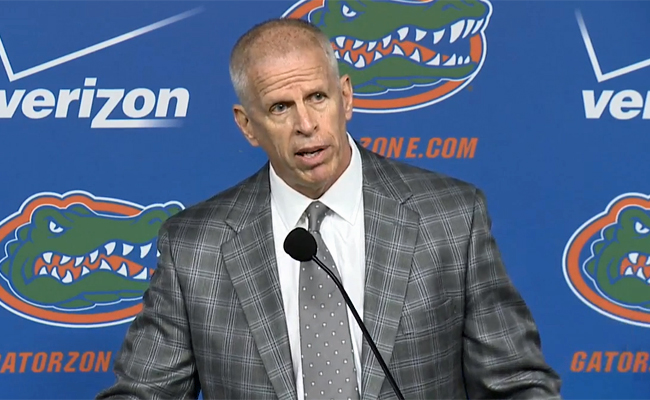
Foley expounded in detail on his time working with the commission for FloridaGators.com. The commission, he said, met with every conceivable party that could touch the targeted issue — apparel companies, the NBA and its players association, agents, AAU coaches, etc. — in order to set a compass for its ultimate groundwork.
"People come to college to play and compete, and for the academics and the degree, the support, the teaching; all the things that are part of the collegiate model, we wanted to reinforce that — and we did," Foley said. "Now, if someone has the ability to go and play in the pros, that's good too. We support that. But those two are separate tracks. I think at least stating that, so the world knows the NCAA and its leadership's stance on that issue, that was significant as well."
In an effort to adhere to the "model," the commission recommended:
* A more thorough enforcement process with harsher penalties for those who violate the rules, including lifetime bans for coaches, if applicable.
* An end to the so-called "one-and-done" rule allowing freshmen to leave school after just one season of competition.
* Mechanisms to allow players to apply for the NBA draft and return to school if they're not selected, as well as consult with NCAA-certified agents during the process.
* A fund to pay for future degree completion for athletes that leave after two years. These items, the committee said, would help pave a pathway to success, but Foley was adamant from the very first meeting back in November about strengthening an enforcement process that not only would hold rules violators accountable, but remove them from the game altogether.
As in those lifetime bans recommended by the commission.
Remember, Foley was on the front lines in the 1980s when UF gained infamy as one of the nation's outlaw institutions, twice going on NCAA probation for football, once for basketball. Foley was named athletic director in 1992 and during his quarter-century in office not one Gators sports team was placed on probation.
"Obviously, the enforcement process has received a lot of criticism — some fair and some not — but it hasn't been affective," Foley said. "The one thing I have learned from my time here, going back to the '80s at Florida, in terms of the culture in our program and the way a culture changes, is that you need a president and coaches and an athletic director that just say, 'We're not going to accept that type of culture anymore at the University of Florida. Period.' Our profession needs to get to the same place. If that stuff is not important to you and you're going to run your business in a certain way, and should that be found out, well, it just can't be a couple game suspensions or giving back a ring or a banner. There need to be consequences that will have credible, lasting impact."
Adherence to the rules, Foley said, was the most pivotal baseline to get the game where his fellow committee members all agreed it needs to be.
As in back to an emphasis on the collegiate model.
Some other notable remarks from Foley:
* On finding a consensus on the issues that most needed to be addressed: "Condoleeza Rice's leadership, as you might expect, was incredible. Her ability to grasp issues and separate what is real and not real, to prioritize, to build consensus, her impact on the report goes without saying. The one thing the group did, under her leadership, the first four or five meetings, we did nothing but listen to people. We listened to shoe and apparel companies. They all came in to see us. The NBA and NBA Players Association came in. We listened to coaches, agents, summer league coaches. The NCAA had a very, very comprehensive survey that was done for all college basketball players. So we spent an inordinate amount of time collecting information. We had the NCAA staff in there and talked about the enforcement process. We had people in there that talked about summer basketball. Once you spend a lot of time listening to people, at some point, the ability to crystalize what we really needed to focus on became apparent."
* On the likelihood that the college game would still thrive if the best prep prospects were allowed to turn pro out of high school: "Of course it would. You're talking about so few players. There are 60 NBA draft picks each year, and 40 percent of those go to foreign players. Now, you're down to 36 players. Well, some of those are going to be taken up by players in college; some seniors, some juniors, whatever. So the number of high school players is not a huge number. The college game is always going to thrive. You know and I know that people come to college, they stay a significant amount of time, they either get their degree, get a head start on their degree, and get themselves on a head start to life. That's not being Polyanna-ish."
* On the issue of using players' images and likenesses: "Now, we agreed that needs to be looked at. We agreed that is something that will need some serious conversations at some point in time, but there are lawsuits on those issues right now and there needs to be some legal parameters set before we know what we can do. Obviously, that was discussed. But it wasn't the time to make any recommendations in that area."
* On some of the negative media fallout that came following release of the commission's findings: "Like I said, people are entitled to their opinions. And I think a lot of people thought we'd come out and all of sudden athletes were going to get paid. That was never part of our charge. We weren't there to study amateurism. We're trying to adjust the culture. Summer league and the lack of transparency is a problem. The lack of transparency with the apparel companies is a problem."
* On whether the recommendations can be policed: "At the end of the day, we'll find that out. But if people don't want to be transparent and are going to put on tournaments, college coaches won't be there. Does that impact them or not? Time will tell. … At some point, the NCAA is going to come up with their own summer camps and tournaments where the college coaches will attend. There will be opportunities for those players to be seen and recruited. Again, that shift won't happen overnight. You don't shift culture overnight. We didn't do that at the University of Florida and we did not do that this week. But you can only change culture when you put measures in place to change it; you adopt them and stay true to them. That's what I see happening here."
* On the NCAA's timeline to put these adopted recommendations in place by August: "Obviously, you can't do anything about summer camps this summer. You can't do anything about one-and-done this year. Some of these things are going to take time. But you start putting the structure in place, start putting the penalty structure in place, and let coaches know and universities know that if they don't cooperate for investigations or run their shops in a way that is contrary to principles of integrity and ethics, there will be some serious consequences coming their way. Like I said, you'll begin to shift it, in my opinion. I've been in the business long enough to know culture does not change overnight. But I'm confident, if we put in place these recommendations, over time, this culture will shift."
NCAA: Coach Walton and Ava Brown Postgame Press Conference 5-22-26
Friday, May 22
Florida Postgame Press Conference | May 21, 2026 | SEC Tournament | Quarterfinals vs. Alabama
Friday, May 22
Florida Baseball | Vanderbilt | SEC Tournament Second Round Highlights 5-20-26
Thursday, May 21
NCAA: Kendall Grover and Cassidy McLellan Press Conference 5-21-26
Thursday, May 21


