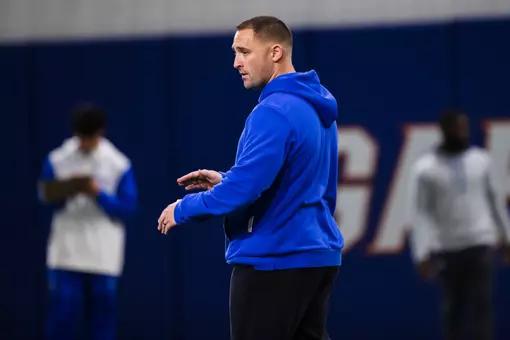
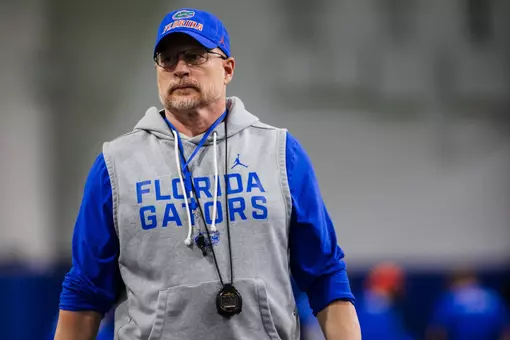
Eddie Haupt was a reserve offensive lineman in 2006 when the Gators won their second national championship. (Photo: Jamie Schwaberow/UAA Communications)
Profiles During A Pandemic: An Eventful Chapter in Haupt's Transformation from Gators O-Lineman to Doctor
Sunday, April 19, 2020 | Football, Scott Carter
Share:
By: Scott Carter, Senior Writer
Editor's note: This is the latest installment in an occasional series looking at the impact of COVID-19 on current and former University of Florida student-athletes.
GAINESVILLE, Fla. – In Urban Meyer's first spring as head coach at Florida, three players enrolled early in January 2005 to get a jumpstart. Quarterback Josh Portis and offensive lineman Ronnie Wilson ended up as UF short-timers.
Eddie Haupt did not.
"I'm the elusive triple Gator,'' Haupt said.
A touted offensive lineman out of Merritt Island High, Haupt developed deep roots here despite injuries derailing his promising football career. Over the past 15 years, Haupt earned his undergraduate, master's and medical degrees from UF. His three kids were born here. Other than for a two-year stint in Texas as a cancer researcher at a children's hospital, Haupt has spent most of his days and nights in Gainesville to launch his medical career.
As Haupt and his family prepare for their next chapter – a move to California this summer when Haupt finishes his residency at UF Health Shands Hospital and starts a fellowship as an orthopedic surgeon specializing in lower-leg and ankle reconstruction – his final months at UF are certain to stay with him forever.
The coronavirus pandemic is not something Haupt spent hours studying until recent weeks.
"Our whole department has changed significantly to be ready for the surge that may or may not come,'' Haupt said. "Everyone's knowledge of the pandemic has changed. Every patient that now comes into the hospital gets tested and we await their test results. We kind of treat everyone almost like they have it just because health-care workers are at such a high risk of getting it themselves."
In Haupt's current role, he is not on the frontline in treating COVID-19 patients and his area of expertise is not infectious diseases. Like tens of thousands of doctors and medical professionals across the country, Haupt is trained and mentally prepared for whatever comes his way on any given day.
Those are the base expectations, not just in historic times like these.
"We are part of the greater hospital team,'' Haupt said. "They call us when they need us. If people have COVID, then we protect ourselves."
Eddie Haupt, who played for the Gators from 2005-07, is now an orthopedic surgeon and finishing his residency at UF Health Shands Hospital in the midst of the coronavirus pandemic. (Photo: Jim Burgess/UAA Communications)
In many ways, Haupt said his training as part of the UF football team from 2005-07 has carried over to his medical career. The 5 a.m. workouts. The long days divided into segments of team meetings, classes and practices. The heightened senses of game day.
They all transfer to the hospital depending on the situation.
"When I was a player, things didn't really go the way as I would have dreamed them at the start,'' he said. "But a lot of those lessons kind of sunk in. They have certainly helped me in my career and life in general. It's very similar to football in that you create a game plan and then you go in and execute it. I really enjoy that."
Dr. Edward T. Haupt remains 6-foot-4, but he has slimmed down considerably from offensive lineman Eddie Haupt, who checked in somewhere between 290 and 300 pounds most of his time with the Gators. A back injury sidelined Haupt his freshman season. However, as a sophomore in 2006, he played in three games as the Gators won the national title. In 2007 he played in one game before a shoulder injury and subsequent surgery ended his career.
In dealing with his injuries, Haupt formed strong relationships with members of the Gators' medical team. He said that played a role in his interest in medicine and prior to his decision to become an orthopedic surgeon specializing in lower-leg trauma, he considered working to become a team doctor.
In the end, Haupt is content in the direction he chose and his extended stay in the UF community.
"It certainly was a long, long road to get here,'' he said. "But I think playing football, I think I learned in those days from Coach Meyer and [John] Hevesy and [Steve] Addazio, that whole staff, the delayed gratification aspect was never a problem.
"Trying to get the best out of yourself and your teammates, that stuff is huge in medicine. People are counting on you, kind of like the football field."
The people relying on Haupt these days don't wear helmets and headsets like when he first arrived at UF. They are injured or sick, sometimes their lives in jeopardy.
And at home, there are his wife and three kids, all ages 4 and younger.
One day, the kids will learn about how their dad spent his final weeks at UF dealing with an invisible opponent that disrupted every game plan in its path.
"It's definitely stressful. My wife is losing a lot of sleep about the whole situation,'' he said. "We have all been reviewing the educational stuff in case they call us into duty. I think the hospital here is doing the right things to protect everyone."