Norm Carlson Looks Back... - Dr. John J. Tigert
Monday, August 25, 2003 | Football
 Dr. John J. Tigert, third president of the University of Florida, had a profound influence on college athletics and the Southeastern Conference, of which he was a founding father in 1933.
He also originated and implemented the grant-in-aid athletic scholarship, adopted following World War II after a lengthy and bitter fight within the NCAA member institutions. He convinced his fellow SEC presidents in 1946 that the hypocrisy connected with under-the-table subsidization of college athletes would be reduced or eliminated by awarding scholarships to cover tuition, room, board and books.
"I believe that athletics are a part of the true college education program," he said at that time. "They what cannot be learned in the classroom."
Prior to that time athletes signed statements that they were receiving no financial help of any kind. Those who were working on campus swore the jobs were legitimate and the compensation was what any other student would receive for the same work. Violations of these rules were rampant and basically went unchecked.
At the l946 NCAA convention Dr. Tigert and the SEC were subjected to a verbal attack from member schools for what they considered to be legalized recruitment of athletes. SEC schools were branded as "outlaws" by the convention chairman, who urged the passage of a "Sanity Code" to prohibit financial inducements to recruited athletes.
Schools that admitted to recruiting on the basis of providing legal funding for a grant-I-aid scholarship were threatened with a boycott by other institutions. The NCCA adopted the "Sanity Code" To solidify the "true amateur ideal." Schools that would not adhere would be dropped from membership.
It was the SEC, led by Dr. Tigert, which fought a delaying action within the NCAA while converts to the grant-in-aid scholarship plan were gained.
The "Sanity Code" was finally defeated in a bitter l951 NCAA convention floor fight and now every major conference in the nation, with the exception of the Ivy League, gives athletic scholarships in programs modeled after Dr. Tigert's original grant-in-aid proposal.
Tigert, who was president of the University of Florida from l928-46, served as one of the SEC's premier leaders and spokesman from l933 until his retirement at UF in l947. He continued to advise conference leadership during his years as University of Florida president emeritus prior to his death in l965. In l970 he was inducted posthumously into the National Football Hall of Fame.
When Dr. Tigert left his position as United States Commissioner of Education in l928 to assume the presidency at Florida, the Gators were one of 23 schools that competed in the Southern Conference. The league stretched from Virginia to Texas and its operation had become a cumbersome task for all involved.
In December of l932 Dr. Tigert was the leader in helping the 13 Southern Conference schools west and south of the Appalachian Mountains reorganize as the Southeastern Conference. Charter members of the SEC, which Dr. Tigert would head as its president, were Alabama, Auburn, Florida, Georgia, Georgia Tech, Kentucky, Louisiana State, Mississippi, Mississippi State, Sewanee, Tennessee, Tulane and Vanderbilt.
Georgia Tech, Sewanee and Tulane would eventually withdraw from the SEC, while Arkansas and South Carolina joined in l992 to create the current 12-school alignment.
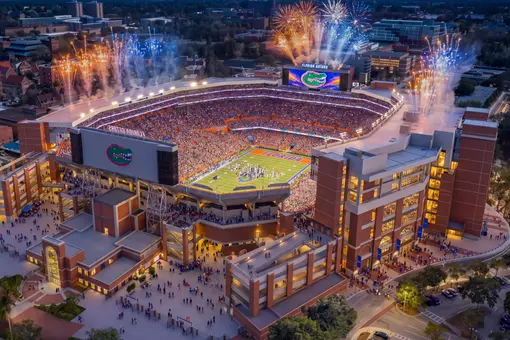
Dr. Tigert, a former head football coach at the University of Kentucky, was the driving force behind construction of Florida Field in l930. Until that time the Gators had practiced and played games on Fleming Field, which is immediately north of the current stadium. Fleming Field was also the site of the varsity baseball diamond at that time.
There was no state funding for the new stadium, so Dr. Tigert and a few friends went out and personally raised the funds, setting up a method to solicit and manage them within the framework of University Athletic Association, Inc. The original stadium cost $118,000.
Dr. Tigert also picked the site. He described it as "west of the swimming pool in the depression near the duck pond. News accounts from that period said the stadium was rising out of a "marshy, ugly depression behind the old red brick gymnasium, and directly south of Fleming Field."
When he named the stadium Florida Field, Dr. Tigert said: "It has been my hope and desire that the field be named Florida Field, after our great state, and that it be dedicated to the Florida men who gave their lives in the World War."
The first game played in the stadium was on Nov. 11, l930 on Homecoming Day against national powerhouse Alabama, a 20-0 defeat. The dedication of Florida Field wasn't until October 13, l934 at the Florida-Tulane game. At that time the Department of Florida if the American Legion placed a bronze plaque on the north wall of Florida Field. Behind the plaque was a casket containing a scroll bearing the names of all Floridians who made the supreme sacrifice in the First World War, l917-18.
Dr. Tigert's concept was the construction of a stadium to be used for football, not a multi-purpose facility with a track surrounding the playing field. Architect of the stadium was Rudolph Weaver of Gainesville and Osborn Engineering Company of Cleveland, Ohio was also employed. This firm had erected more football stadiums than any other company in the country, according to newspaper accounts.
The natural depression was very helpful but 55,000 cubic yards of soil still had to be removed before construction commenced on April 16, 1930. The work force included mules and 80 men.
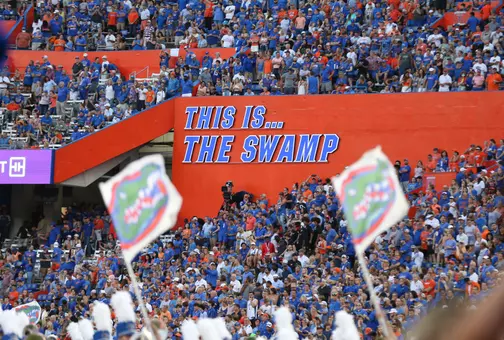
Architect Weaver made a decision in l929, which still has a profound effect on Florida football. Instead of the normal oval or "horseshoe" stadium design found all over the country, he built the north end zone as a straight construction, thereby providing three straight sides on the west, east and north. This, combined with the elimination of space for a running track, means that to this day Florida fans are closer to the field and more a part of the action than almost any stadium in the land.
The stadium seating capacity was 21,769 and it was constructed entirely below ground level, containing 32 rows on the three straight sides. Fans entered at row 32, which is 25 feet about row 1 and stretches back only 71 feet from the playing field.
It was a unique concept dreamed up by Dr. Tigert, a man with great vision.