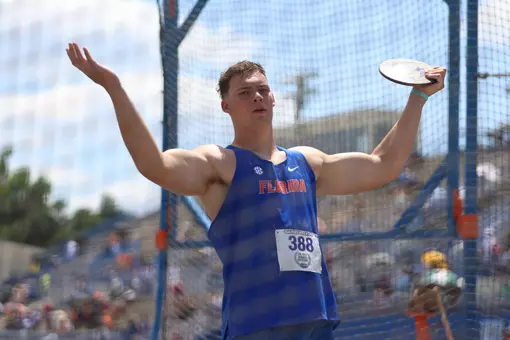
From Hard Work Came A Champion: Florida's Gray Horn
Sunday, August 2, 2009 | Track and Field
By: Sean Cartell
UF Communications
The sun hasn't yet risen in the tiny farm town of Wapakoneta, Ohio, but the retired Joe Horn is already up and making the drive to Waynesfield-Goshen High School.
It has become a ritual for the elder statesman of the Horn family which, combined, holds the track and field records in 13 different events on the boys and girls sides at Waynesfield-Goshen. Horn, as a volunteer, opens the weight room each morning to begin scratching out workout plans for nearly every athlete – regardless of sport – in the school.
“My grandfather is the man that I still, to this day, thank for my success,” said Gray Horn, who just completed his freshman year as a multi-event athlete at the University of Florida. “He gets up every morning and goes to the weight room – something he's not paid to do. He writes training plans for every kid in the school to help them get to where they want to be. He is always pushing people to the limit and he does it for free.”
Wapakoneta is a farm town of 10,305 residents in western Ohio, which beginning in 1780 functioned as the capital of the Shawnee nation for more than 50 years. The city, which served as a central shipping location during the railroad era, is perhaps best known as the hometown of astronaut Neil Armstrong.
The community now is primary comprised of farming ventures. It is a place where old-fashioned hard work and discipline serve as the staples of each resident's belief system; No resident is more dedicated to that mentality than Joe Horn.
Horn began mentoring his grandson, Gray, in the principles of hard work and track and field at around age 10. Those experiences translated to successful employment on a local farm starting approximately five years later. Gray Horn's labor-intensive farming duties consisted of bailing hay and working with cattle.
“Probably since I was about 15 years old, I worked for a couple different guys on farms,” Horn said. “I would mix manure and then actually feed the cows, then I'd go bail hay and deliver the hay. It's a lot of hard work. You're picking up the bails of hay, and tossing them into the loft. It's rough, but it taught me a lot of discipline to where it hurts so much to keep working, but you're working with other people to achieve a common goal.”
Farming taught Horn same lessons that his grandfather was teaching at the high school and at home, a concept that would transform into a successful track and field career.
“I think any successful person in life has a story like that,” Florida head coach Mike Holloway said. “You have to have somebody who is a driving force who teaches you lessons. His grandfather is a great person. His whole family is full of hard workers.”
Florida's multi-events coach Mellanee Welty says that the impromptu instruction that Horn learned back in Wapakoneta is what has continued to make him successful in track and field.
“Gray is just a farm kid from Ohio who knows what it's like to work hard,” Welty said. “He's athletic and he had pretty good marks in high school, but maybe most people didn't necessarily know who he was. He is a very, very athletic guy who, most importantly, has a great background for working hard.”
More than a year ago, Horn told local Ohio newspapers that he fell in love with the Florida campus upon his initial visit and couldn't have seen himself competing anywhere else. Horn was part of the nation's No. 1 recruiting class as judged by Track and Field News in 2008 and came to Florida ready to break records by focusing on doing the best he possibly could.
Welty, an All-America heptathlete in her own right at Wichita State, had been watching Horn since his sophomore season in high school and knew he had all of the right tools to thrive in the Orange and Blue.
“I've had the opportunity to watch his state meet since his sophomore year and I thought he could be a really great one,” Welty said. “I knew that he came from a good family and was an athletic kid. Small-town kids are normally very hard workers. He is really a student of the sport. Gray watches a ton of video and does a lot of visual imagery. Things most coaches have to teach, he does on his own.”
The decathlon is a natural event for Horn, who played a number of sports in high school and wasn't satisfied with focusing on just one track and field event. He says that it is his personality that suited him for the multi-events.
“It's like what a lot of the really great decathletes have said – the decathlon kind of chooses you, you don't really choose it,” Horn said. “Most people just want to be good at one event and I'm not that way. I played four or five sports in high school and I get bored if I just do one thing. That's just my personality and that's the reason that the decathlon chose me.”
Horn says it's the discipline he learned as a teenager on the farm that has allowed him to have the endurance to train and compete in the decathlon.
“It's constant work 24/7 and it never stops,” Horn said. “I can definitely credit a lot of the discipline I learned in farming to what keeps me going in the decathlon. The job has to get done on time and it takes strength to keep pushing through adversity.”
From the outside, it might appear that it would be difficult to excel in 10 different events and be able to understand the nuances of each, but, according to Welty, despite the difference in training, most of the events have similarities.
“You still have to be a perfectionist as far as the big picture,” Welty said. “The concepts are all the same. You still have to be able to perfect certain concepts even though you don't do the same thing twice or three times a week.”
Under Welty's direction, Horn has one of the most comprehensive training programs of any decathlete in the country. In addition to Welty's position as multi-events coach, Horn benefits from the expert knowledge of throws coach Steve Lemke and Holloway in the sprints and hurdles.
“I think the biggest thing is that you have to have an overall plan and I think Mellanee does a great job of putting that together,” Holloway said. “But if you have great coaches on staff who fit into that plan and can contribute, I think it's smart to do that. I don't think that there's any way that you have a throws coach on campus with the experience of Steve Lemke and you don't utilize him in the multi events.”
Horn feels like that combination of training from a number of different experts prepares him to be one of the best decathletes in the country.
“Coach Welty works really hard at what she does in creating my training plan,” Horn said. “I feel like we are going make a great team over the next few years. Coach Lemke is the best throws coach in the country, as far as I'm concerned. I've never worked with anyone who knows the events more or is more patient with you. I feel like Coach Holloway is one of the best coaches in the nation as far as sprints and hurdles. They've really helped me make that next step, but there's a lot more steps to take.”
Horn began his freshman year by participating in the heptathlon at the Southeastern Conference/Big 12 Showdown in College Station, Texas, before posting a second-place finish in the event at the SEC Indoor Championships in Lexington, Ky.
Cheering from the stands in each of those meets were members of Horn's family.
“Having them there just makes it feel like home,” Horn said. “It's comforting to know that I have my grandfather and dad in the stands with their Florida Gator gear on supporting me wherever I go. It's really an overwhelming feeling. I can't describe how much I appreciate them being there.”
Horn headed for the NCAA Indoor Championships in College Station, Texas, where he looked to be headed for All-America status. Entering the meet ranked 11th in the nation in the heptathlon, Horn tied the school's first-day hepathlon record with a tally of 3,137 to put him in seventh place through four events. He set personal bests in both the long jump and the shot put en route to his record-setting opening day.
The next day, Horn followed with a 10th place finish in the 60-meter hurdles before facing adversity. He failed to clear a height in the pole vault and finished the heptathlon in 14th place, dashing his All-America hopes at that event.
“I was having the best meet of my life at NCAA Indoors,” Horn said. “I just got to that one event where I was off and I didn't stand a chance in the vault that day. It just wasn't going to happen. It was a good learning experience to get that out of the way now to give me motivation to never let that happen again, because it hurt.”
Welty agrees, saying that Horn's experience in the pole vault at the NCAA Indoor Championships went a long way in teaching the freshman some important lessons.
“'NCAA Indoors was difficult,” Welty said. “He was a pretty good pole vaulter in high school, but we've struggled with the vault all year. That's typical for a freshman decathlete. That taught him a lot of lessons and kind of humbled him a little bit in terms of coming back and reevaluating. I wouldn't want something like that to happen to an athlete, but he's much better today because of that.”
Horn began his 2009 outdoor season by participating in several events at the FSU Relays in late March before heading to the Clyde Littlefield Texas Relays in Austin, Texas. Though it had only been about three weeks since the NCAA Indoor Championships, Horn returned to the track with an increased determination, showing no signs of disappointment.
“The nice thing about Gray is that he's a very self-motivated young man,” Welty said. “He definitely had to reevaluate things, but it gave him a lot of confidence going into outdoors. It was definitely a good place for him to be in.”
Horn excelled at Texas Relays, turning in the fifth-best decathlon score in school history with a mark of 7,067, despite having to battle stiff winds that halted the competition in the late afternoon and forced the meet to go well into the night.
Next up for Horn was the 2009 SEC Outdoor Championships, which would take place on the Gators' home track at James G. Pressly Stadium. The event was fraught with rain and weather delays that would force the competition to continually be suspended.
It appeared all through the opening day of competition that Horn was struggling, but he finished a very long opening day in first place with 3,809 points.
“I think with me being a freshman, I probably got a little too excited with the hype of the SEC,” Horn said. “It was just all the rain delays and the different hypes and pressures. It's a great meet, but you need to go into it knowing that it's just another meet. Be yourself and perform at your own level. You shouldn't set any high expectations and I did – and it showed in my first three events. Once I got to the high jump and finished the last three events of the day, I was fine.”
Horn excelled the next day in the hurdles and the discus, and set himself apart from nearest competitor, Tennessee's Michael Ayers, with a collegiate best in the pole vault. He struggled with an eighth-place finish in the javelin and entered the 1,500-meter run knowing that he would need to beat Ayers by approximately nine seconds in that event to capture the decathlon.
Horn turned in a collegiate-best time of 4:29.19 in the 1,500m to capture the first league decathlon championship in school history, accomplishing that feat in just his first year in Gainesville.
“After the pole vault, we really thought that he was going to win,” Welty said. “Ayers had a huge javelin, but Gray just came back from that and said 'How fast do I need to run?' He was really determined and decided to go out and lay it out on the line. He believed from the first event that he could win the decathlon. For me, it was just about keeping his mind focused and telling him that we're not doing 10 events at a time.”
Horn's new mentality, which he acquired after battling adversity at the NCAA Indoor Championships, helped him keep his focus through the final event of the SEC Championship decathlon.
“It's just event-by-event and you can't quit no matter what because each guy still has a chance of messing up in one event,” Horn said. “I threw not so good in the javelin, but I came back in the 1,500 and won it. I didn't quit and we were able to get through it.”
Horn had done something that no other person in Florida history had ever done – win an SEC decathlon championship – by simply using the principles that his grandfather and his experiences on the farm had taught him. Holloway said the experience of watching Horn win the conference title was very fulfilling.
“I'd like to say that I had a crystal ball and knew he was going to win, but I don't know if anybody in that stadium thought that Gray was going to win that, except for maybe him,” Holloway said. “All we could hope is that he would put himself in a position to do that, and it was really a great feeling to watch him. I really enjoyed watching him in the 1,500-meters. He bared down that last 500 meters to win and it was really amazing.”
Horn completed his freshman season with an All-America finish at the NCAA Outdoor Championships in Fayetteville, Ark., and has his sights set on continuing to be the best decathlete in Florida history and, more importantly, the best decathlete he can possibly be.
Horn has plans to pursue a professional track and field career and be a medalist at the Olympics but once his track and field career is over, the decathlete looks to return to his roots and give back by teaching the lessons that made him the person he is today.
“I can't see myself doing anything but coaching, at the college level and maybe at the high school level one day,” Horn said. “I am working towards my teaching degree in history right now. Right now, I'm just working on doing my thing and being the best I can be.”
And that “best” is pretty good for the soon-to-be sophomore, who this weekend recorded a second-place finish at the Pan Am Junior Championships in Port of Spain, Trinidad.
After all, getting up before dawn to work harder than everyone else is nothing new for members of the Horn family.
END OF REPORT