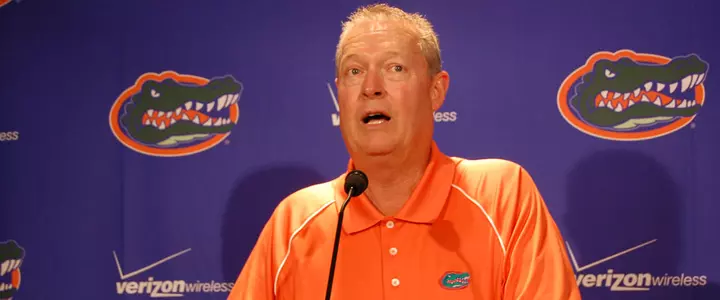
GatorZone.com Sits Down With Buddy Alexander, Coach Of The Top-Ranked Gators
Monday, October 11, 2010 | Men's Golf, Scott Carter
GAINESVILLE, Fla. – University of Florida men's golf coach Buddy Alexander is the dean of the Gators' coaching fraternity.
Alexander arrived at UF in January of 1988 and is the longest-tenured coach in UF's athletic department.
During his time at UF, Alexander has led the Gators to a pair of national titles (1993 and 2001) and built the men's golf program into one of the most respected in the country.
The Gators are playing in the Jerry Pate Invitational today and Tuesday at the Old Overton club in Birmingham, Ala.
GatorZone.com had a chance to sit down with Alexander recently for a conversation with Alexander about his time at UF and some of his most memorable experiences in golf.
Here is a transcript of that conversation:
Q: When you first arrived at UF and took over the program, what were your expectations?
A: I certainly didn't envision myself being here this long. I didn't have any goals of being the longest-tenured coach or maybe the longest-tenured in the history of the athletic department. Somebody said I'm gaining ground on it. I had been at LSU for five years and then I had gone to work at IMG [International Management Group]. My wife stayed in Baton Rouge and we had a 3-year-old. If this job hadn't opened up, I would probably still be living in Cleveland, Ohio. I liked it, but for a Southern boy living in Cleveland by himself in the wintertime, and his dream coaching job become available, it was a little too much to turn down. And to be honest, I kind of felt like I would come down here and do this for a little while – I wanted to win a national championship – and then I would probably do something else. I just never got around to leaving. It has worked out great.
Q: How did you go from IMG to head golf coach at UF?
A: It was a great experience for me, and I was fortunate to have that opportunity, but the Florida job was just the right fit at the right time. Bill Arnsparger was the athletic director and he had been the football coach at LSU, so we had a little connection there. He called me and asked me if I was interested in November when they first let this guy go. I told them no, that I was committed to what I was doing. He was like, 'Then you've got to help me, because I don't know anything about golf.' They were in no hurry because it was in the middle of winter. He would call me about every two weeks and he would end every conversation with, 'Well, what about you?' I'd go, 'No, I'm OK.' Then, at Christmas time, IMG just kind of closes up for about a week. I went to Baton Rouge and it was [great weather] for about a week. And when I got back to Cleveland, it was about 30-below. And Bill called me and goes, 'OK, I'm down to this guy and this guy. What about this guy?' I'm like, 'Hey Bill, what about me?' That's how it happened, true story.
Q: Did you know when you were younger that you wanted to be a golf coach?
A: I knew that I didn't want to be a club professional. I wanted to play the tour. That was my goal. That was the thing that I think every kid who comes into this program and every kid who has ever spent hours and hours out on the range and on the golf course by himself, most kids want to play the tour. It looks pretty glamorous. Everybody thinks they have a shot. I was your typical kid and I was a pretty good college player. I made some All-American teams, but I wanted to play the tour and I wasn't quite good enough. So when you are growing up, you have to look at some other options that might work for you. I understand that a lot of times guys that end up being butchers wanted to be doctors, but they might not have been quite bright enough. Maybe I wasn't good enough to play the Tour, but I didn't want to be a club pro because I had seen that side of the business growing up in a house where my dad was a club pro. I think that's a great way to make a living, it just wasn't for me and my personality.
Q: Did your dad get you into golf?
A: My dad was a Tour professional before he was a club pro. In fact, he played on a couple of Ryder Cup teams. He was very successful, but then he was in an airplane accident that ended his career. It ended pretty abruptly for him. But I looked at my [college] coach and said, 'You know, that's not a bad deal. That's a fun way to stay in golf.' But I pretty much had blinders on until I had played professionally. After that, I thought, 'Yeah, I want to try that for a little while.'
Q: You still play some competitive golf?
A: Very little. I just got back [Wednesday] from the U.S. Senior Amateur. I played professionally, and now I've got my amateur status back. I won the U.S. Amateur. I played some competitive golf in the late-'80s and '90s. Toward the middle or the end of the '90s, I started playing much less competitive golf. This year I played one one-day tournament and one two-day tournament in the Senior Amateur. I don't have time [to play a lot], and my back is not that great. But I played great and I had a good time. I don't know how much more competitive golf I'll play, but I've had a nice run. I will say I think playing competitive golf has helped me be a better coach.
Q: How so?
A: It keeps you in tune with what a competitive golfer is doing. I think it's easy to lose sight on this side of the desk that the game is a lot harder than it looks. There are a lot of things that you do in tournaments and in preparation for tournaments that you might not think about if you still didn't do it. That's the one reason that I don't really want to give up playing competitive golf. I want to keep doing it was a while because I think it makes me a better coach.
Q: What's the best day you've ever had on a golf course?
A: Winning the U.S. Amateur was a very special thing. That was a great day. I played with Jack Nicklaus at The Masters. That was a pretty cool thing. I played on a winning Walker Cup team. But there is no greater satisfaction for me than winning national championships. When you go an entire year with a group of guys and you put it all together, the greatest day was probably the first one. The second one was probably the most unbelievable. We were tied for the lead going into the last day and won by 18, so that was a pretty cool day. We shot 17-under on the Front 9. Do the math on that. They averaged better than 32 on the final day of the national championship. I've been fortunate to have a lot of great days. I hope I have a few more.
Q: What has changed the most in the game since you took over UF?
A: It has changed considerably. The equipment is the biggest change. The game has become a power game much more so than a finesse game. The balls are better. The clubs are better. They are more forgiving, which allows you to swing harder at it. And the athletes are better. There is no question that our kids and Tour players are working their tails off to make themselves bigger, stronger, better. We've got technology that can tell you ball speeds and club-head speeds and launch angles and things like that. Those are things that we obviously didn't have when I was in college or even came to the University of Florida. There is no question things have changed.
Q: How has the game adjusted to the better technology?
A: What the traditions of the game are doing is that they are compensating for that by playing longer golf courses with faster greens. At Chambers Bay [in University Place, Wash.], where they played the U.S. Amateur in August, is 7,600 yards long. When I was in college, if a golf course was over 7,000 yards long, it was considered to be a beast. If it was 7,200 yards, it was, 'Wow, I hope they are not using all of the golf course.' Now you've got one that is 7,600 yards and they are using a lot of it. It's pretty amazing. But the game has got to defend itself. Unfortunately, some of the older golf courses are land-locked and they are going to be unable to defend themselves.
Q: What do you think the hardest shot in golf is?
A: The hardest shot in golf is probably a putt to win. But in answering your question, probably a short fairway bunker shot … a 70-yard bunker shot because it's too far to blast. It's just hard to hit that shot solid. It's not a full swing. That's generally what most people think is the hardest shot in golf. But you could elaborate on that and go into lies and bunker shots with a deep-faced bunker.
Q: How many hole-in-ones have you made?
A: I've made a couple; not that many. I've got an interesting hole-in-one story. I made my first hole-in-one when I was 8 years old on a par-3 course. It was 70 yards at Twin Brooks in St. Petersburg. I made it with a 3-iron. The next one I had was in college at Augusta National's par-3 course. It was 70 yards and it was with a sand wedge. So the first two hole-in-ones I made were on a par-3 course, so technically those are illegitimate in a roundabout way. I made my first hole-in-one in 1986 after I had won the U.S. Amateur, and it was with a 4-iron. Since then, I've made three more. I don't have many, but I've got a couple.
Q: What's your most memorable moment at UF?
A: Probably walking up the 18th fairway in 2001 at Duke with Nick Gilliam. He won individually and that was the day we won [the NCAA title] by 18. He just shot some terrific scores that week. He was our No. 4 man and he won the NCAA Tournament. It doesn't mean he wasn't a very good player. He was a very good player. But he wasn't the best player on that team. Walking up that last fairway knowing that we had won, knowing that he had won, that would probably be my most memorable moment on a golf course with my team. That was pretty special. There have been a lot of memorable players and kids I love.
Q: What keeps you loving this game after all these years?
A: I think the one thing that probably motivates me is the fear of failure. I can't stand the thought of being mediocre. I think that motivates me to go at it as hard as I do. What motivates me on the other side is just the love of coaching and watching these kids get better. When you have a small roster – I don't know how close Urban [Meyer] gets to every kid on his team – but when you only have nine guys or eight guys on your team, and you're only playing five at a time, and you're traveling six hours in a van a couple of times a year … you get to know each other pretty well. I think it's pretty obvious that you become a pretty influential person in that kid's life. It's a great way to live your life. You're helping kids and you are watching them grow. Not just the success on the golf course, but the success they have in terms of graduation and going on have being successful in society. I guess that what motivates me to do the job, and then the fear of failure motivates me to do it the best I possibly can.


