Carlson's Gator Tales: Graves Took Florida to New Heights
Thursday, October 23, 2014 | Football
By NORM CARLSON
Assistant Athletics Director/Gators Historian
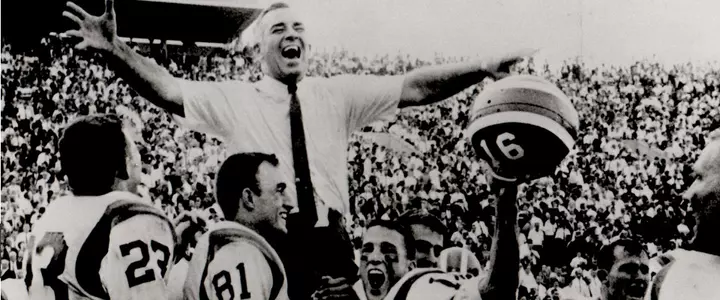
GAINESVILLE, Fla. -- When Ray Graves took the head football coaching job at Florida following the 1959 season at a record UF salary of $17,500, he left a wonderful, secure job as defensive coordinator at Georgia Tech under his longtime friend, Bobby Dodd.
Dodd sat up on his tower at Rose Bowl Field in Atlanta and supervised the entire field. Graves ran the defense and Dodd, his friend, fellow Tennessean and former star Vols quarterback, watched from his perch and never interfered.
However, the Dodd-developed offense was the most difficult to defend, as Graves got to see it each afternoon. Ahead of its time, it was wide open and spread the defense out in coverage.
One of Dodd's finest players was quarterback Pepper Rodgers, who would eventually join Florida's staff as its offensive coordinator. Rodgers had an exceptional mind for offense and how to play the quarterback position, and was able to deliver his ideas to his quarterbacks in language they understood.
Florida's offense became explosive and Graves, who was also Florida's athletics director, recruited a young quarterback from Science Hill High in Johnson City, Tenn., who wanted to be a part of it instead of going to Knoxville to play in the single-wing. That player was Steve Spurrier, and the Gators were the beneficiaries of his decision.
Rodgers eventually moved on to NFL work and is now retired and living in Virginia.
Graves, the defensive guru, also knew offense. He also was a master of the kicking game.
“I've been coaching defense many years and I've seen most of the offenses,” Graves said. “I think I know what offenses have given defenses the most trouble. So, we're going to play wide-open football, spread the field out. We're going to keep on playing wide-open football. Recruits like it, players like, fans like it and I like it.”
It was even better following the defense, punt-on-third-down methods of the Bob Woodruff years. Woodruff, an outstanding football coach and athletic administrator, not only produced the first consistent overall athletic program at UF, balanced the budget and watched over stadium additions; he also gave the program creditability on campus and around the state for all the sports.
He was not a public speaker and received the moniker of being “the rhetorical equivalent of a blocked punt.”
Woodruff had an outstanding linebacker named Steve DeLaTorre, who was an honor student, commander of the cadet ROTC unit and captain of the football team. When asked to comment about DeLaTorre's accomplishments, Woodruff replied, “Yes, he is captain of the team, an honor student and commander of the ROTC.”
So much for lengthy dialogue.
Graves' team finished with a 70-31-4 mark in his decade, second only to Spurrier, who was 122-27-1 at UF. Between the two of them, they had a combined 192-58-5 record as UF head coaches, and Spurrier was 23-9 as a player.
That is a substantial percentage of Florida's total wins in 108 years of football.
In 1966, the Gators were 9-2, scoring 265 points and beating Georgia Tech in the Orange Bowl, 27-12. Spurrier won the Heisman Trophy, center Bill Carr was a fellow first-team All-American, and both joined flanker Richard Trapp, guard Jim Benson and tailback Larry Smith on the All-SEC team.
One of the assistant coaches on offense was former Gator star running back Lindy Infante, who became an outstanding NFL head coach with the Green Bay Packers and a recent inductee into the Florida-Georgia Hall of Fame in Jacksonville.
Offensive coordinator Fred Pancoast was an exceptional coach who went on to become successful as the head coach at Vanderbilt, then retired in Nashville, where he and his wife, Carolyn still live. Pancoast coached the 1969 offense at Florida, including the “Super Sophs” backfield of John Reaves, Carlos Alvarez, Tommy Durrance and Andy Cheney.
Gene Ellenson was the head defensive coach and one of the nation's finest. His units played with passion and the former hero of the Battle of The Bulge in World War II was a master motivator. Florida defenses were tough and proud, and playing the toughest schedule in Gator history at that time they only allowed 98 points, less than a TD and field goal per game.
In addition to the coaching, Graves hosted a function at his house on University Avenue for friends and the media after each home game and another one at a Jacksonville downtown hotel after the Georgia game.
That is all history. Times have changed. Graves, now 95, lives in a retirement home in Tampa and Gator athletics moves on.
![Images from the Florida Gators August 2024 Graduation event on Friday, August 9, 2024 at the Stephen C. O'Connell Center in Gainesville, FL. [Photo: Matt Pendleton Photography for Florida Gators Athletics]](https://images.sidearmdev.com/resize?url=https%3A%2F%2Fdxbhsrqyrr690.cloudfront.net%2Fsidearm.nextgen.sites%2Fgatorzone.com%2Fimages%2F2025%2F4%2F30%2FCap_commencement_detail_240809_1400_Matt_Pendleton_Photography_for_Florida_Gators_Athletics__1_.jpg&height=340&type=webp)


