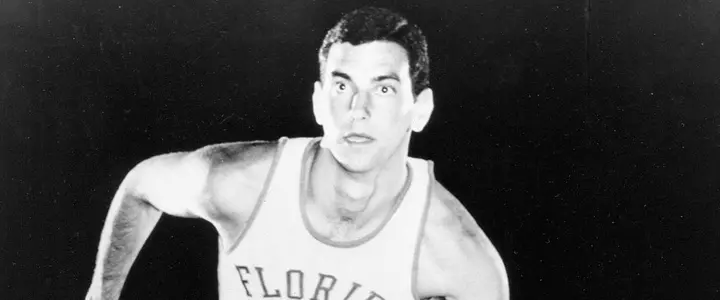
Gator Great Neal Walk Dead at 67
Monday, October 5, 2015 | Men's Basketball, Chris Harry

Neal Walk, the first All-American in Florida basketball history, speaks to former Coach Billy Donovan during an NCAA Tournament practice at Phoenix in 2012. Walk died Sunday after a lengthy illness.
GAINESVILLE, Fla. -- Neal Walk and Kareem Abdul-Jabbar forever will be linked.
Abdul-Jabbar (then Lew Alcindor) won three NCAA championships at UCLA, was the No. 1 overall pick in the 1969 NBA Draft by the Milwaukee Bucks and went on to win six league titles (one with the Bucks, five later alongside Magic Johnson with the Los Angeles Lakers) and six MVP awards.
Sad news, as former Suns forward Neal Walk (1969-74) passed away tonight. Our thoughts are with his family. #RIPNeal pic.twitter.com/U0PhcULcUr
— #WeArePHX (@Suns) October 5, 2015
Walk, the most decorated and dominant player in University of Florida history, was selected No. 2 overall in '70 and went on to play nine solid-though-not-spectacular seasons in the NBA.
And yet years, after both were out of the league, Walk finally managed to get the best of Abdul-Jabbar. He can thank Billy Donovan for that. And Joakim Noah. And Al Horford. And Corey Brewer. And everyone from those 2006 and 2007 UF teams that steam-rolled through a couple UCLA squads en route to back-to-back national championships and college basketball immortality.
“I wanted to go to those games so I could rub it on on Abdul-Jabbar -- and I finally did the next time I saw him. Yeah, I had some fun with that,” Walk told GatorZone.com in 2012 when he attended a Gators practice during the NCAA Tournament at Phoenix. “Yeah, I gave him a zing or two.”  Walk, the No. 8 scorer and all-time leading rebounder in UF history and the only Gator to have his uniform number retired, died late Sunday. Walk was admitted to a Phoenix hospital two months ago in poor health. He was 67.
“Neal Walk holds a special place in the history of Florida basketball, and we will always be grateful for what he did for this program," UF athletics director Jeremy Foley said. "He was a good, good Gator. Our thoughts are with Neal's family and loved ones at this time.”
Confined to a wheelchair since 1988 following surgeries to remove a benign tumor from his vertebrae, Walk retired from professional basketball in 1978 and for nearly three decades worked in the Phoenix Suns front office, the last 15 years archiving digital images from the team's games and public events.
But a half-century ago he arrived at Florida and changed the Gators program.
Born July 29, 1948 in Cleveland, Walk was 6 when his family moved to Miami. His first game at UF came 14 years later -- mere days after Gators quarterback Steve Spurrier won the Heisman Trophy -- for first-year Coach Tommy Bartlett.
The 6-foot-10, 220-pound Walk broke onto the scene as a sophomore in 1966-67 (freshmen were ineligible) and promptly averaged 11.5 points and 8.2 rebounds while leading the Gators to a 21-4 record that set a school record for wins in a season.
In a game against Kentucky, he went for 33 and 28. As a junior, Walk averaged 26.5 points and 19.8 rebounds that led the nation and included a 31-rebound game against Alabama. His senior numbers showed 24 points and 17.8 rebounds per game.
When he was done, Walk had scored 1,600 points and grabbed 1,181 rebounds, the latter figure still tops among UF players and ninth-best in league history (with his 19.8 average still second best). In games against Kentucky, Walk averaged 24.7 points and 22.5 boards.
His Florida teams went a collective 54-23 overall, with second- and third-place finishes in the SEC, the program's greatest three-year stretch at the time.
Because only conference champions reached the NCAA Tournament in those days, Walk's only taste of postseason play was a first-round loss to Temple in the NIT his senior year.
Just six days after that NIT game, the NBA held a conference call between the league's two worst teams, the Bucks and Suns, where a coin toss would determine who would have the No. 1 overall pick in the '69 draft.
Suns owner Jerry Colangelo called tails.
The Bucks drafted Alcindor and a year after finishing 27-55 flipped that record to 56-26, with Alcindor (28.8 points, 14.5 rebounds, 4.1 blocks) named Rookie of the Year. Milwaukee won the NBA title a year later.
The Suns selected Walk second, where he remains the highest-drafted Gator in UF basketball history.
Walk averaged 12.8 points and 8.5 rebounds as a rookie, numbers that came very close to his career stats of 12.6 points and 7.7 rebounds. Worth noting: On Jan. 11, 1972, Walk hung 42 on Alcindor and the Bucks in a one-point win at Milwaukee (that one had to feel pretty good).
He was traded to the expansion New Orleans Jazz in 1974, where he played with Pete Maravich. His final NBA season was with the '75-76 New York Knicks when he and a fellow named Phil Jackson shared minutes at the center spot.
“People didn't appreciate how good he was on the court,” Steve Rich, Walk's longtime friend and former roommate, told The Arizona Republic. “He felt unappreciated. Instead of appreciating him for what he could do, they always compared him to Jabbar. He was as smart as any athlete I've ever met. Neal liked it when he was seen that way.”
After the NBA, it was one pro season in Italy and retirement.
The surgery that ultimately took Walk's ability to walk did not end his basketball career. He played in a traveling wheel chair league for five seasons and was honored in 1990 as the game's player of the year. In 1995, he received the Gene Autry Courage Award from the Tempe (Ariz.) Sports Authority Foundation, and in 2006 Walk was inducted in the Jewish Sports Hall of Fame.
In 1997, UF retired Walk's No. 41 jersey was officially retired in a ceremony before a game (photo below) and inducted the Gator Great into the UF Athletic Hall of Fame.
Walk is survived by his wife Georgia and a brother.

![Images from the Florida Gators August 2024 Graduation event on Friday, August 9, 2024 at the Stephen C. O'Connell Center in Gainesville, FL. [Photo: Matt Pendleton Photography for Florida Gators Athletics]](https://images.sidearmdev.com/resize?url=https%3A%2F%2Fdxbhsrqyrr690.cloudfront.net%2Fsidearm.nextgen.sites%2Fgatorzone.com%2Fimages%2F2025%2F4%2F30%2FCap_commencement_detail_240809_1400_Matt_Pendleton_Photography_for_Florida_Gators_Athletics__1_.jpg&height=340&type=webp)


