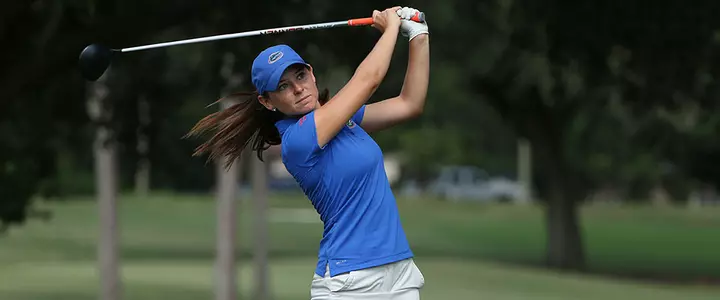
Senior Year Marks New Beginnings for Women's Golfer Laura Kanouse
Tuesday, November 10, 2015 | Women's Golf
By RJ Schaffer, GatorZone.com Intern
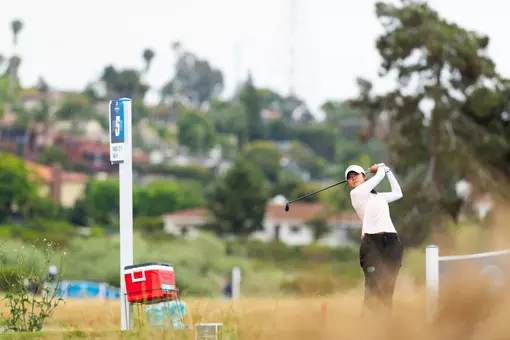
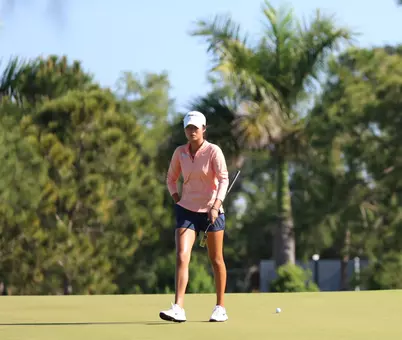
GAINESVILLE, Fla. - Laura Kanouse sits in the conference room at the Mark Bostick Golf Course. She is wearing a blue, zip-up Gators sweatshirt and a blue Gators hat to match. Mere yards away sits the course where she has spent countless hours playing and practicing on. It is no different than it was yesterday or the day before, but the woman who swings away on it is.
After three years of practicing in the shadows of the stretched pine trees, Kanouse now finds herself playing for something greater than herself. She created the Florida Club Golf team that won the 2015 NCCGA National Championship and the senior is now in her first year as a walk-on on the Florida Gators women's golf team. She describes herself as being “really good” at both academics and athletics. Although her dad was a golfer, none of her other four siblings wanted to play golf. She became the exception and began the sport at age three, which means that she was playing golf before she literally could even remember playing golf.
Kanouse played on the links throughout her childhood. She experimented with other sports, but golf would always reign supreme and her weekends would always be filled with different tournaments in other parts of Florida. The dream of being a member of a big school's program was the dream forever. Combined with the academic prestige of the engineering school—her major--, the University of Florida seemed like a logical choice. Former head coach Jan Dowling spoke to her about the chance to play for the Gators but ultimately decided not to offer her a spot. Current Florida coach Emily Glaser was also in contact with her, but again the decision stayed the same.
She came to UF over the decision to take a walk-on spot at Notre Dame, somewhat in part because the snow and being forced to play golf indoors all winter didn't appeal to her. She played less golf her freshman year than she did the rest of her life. The itch began to come back. She emailed Glaser and was told that since she hadn't played in a year that she would need to play in some tournaments so her skill set could be reevaluated. She was also told the team, “really doesn't do walk-ons.”
Despite what looked to be slim odds of ever donning the Orange and Blue, Kanouse began her unlikely journey to becoming a Division I athlete. Tournaments could be an easy one to check off the list. The only problem was UF didn't have any club golf team for her to be a member of. No matter, she went and formed the club herself. Despite all of the other golfers in Gainesville who could have started the club years before, she thinks she did it because she had the competitive drive.
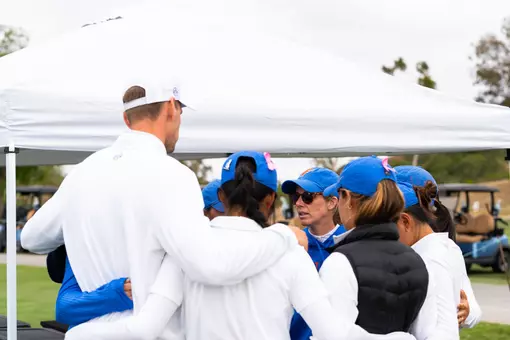
That dedication and attention to detail was what initially impressed Glaser. The walk-on spots are coveted to Glaser. With such a small number of players on the team, adding even one new member could potentially mix up the chemistry that the team may already have. Kanouse personally recruited the members mostly by word of mouth at the course, where many members of the club team worked or played already. She was the only woman on the team and, as co-founder, she set up all the tournament plans and made sure the team could get to all of the locations, some which were as far as North Carolina, Mississippi and New Jersey.
Success was immediate, as the team went to three straight national championships, beginning with the first semester on campus. In 2014, she won the NCCGA Florida Regional and tied for fifth at the national championship. This year brought the aforementioned title for the team, when she tied for 11th with a 36-hole total of 151. She also placed in the top-25 at both the Florida Women's Amateur Stroke Play championship and overall championship. It was time to take another shot at the dream she had before the club team.
Little did Kanouse know how much of an impact her work with the club team had, but Glaser remembers first being impressed with how often she was at the course practicing. Once she became aware of the club team and how much time Kanouse was putting into the game on her own accord, the decision to offer her an official spot became an easier one to make.
“I emailed Emily and said, 'Is there any way I can practice in the back?'” Kanouse said. “And she said, 'Oh, we're actually going to give you a spot.'” Glaser defined Kanouse as an ambitious young lady whose persistence and dedication set her apart from the pack. “You don't want to have to be chasing a walk-on around and begging them to practice,” the Gator head coach acknowledged. “You want them to get better and certainly she was putting in the time.”
She was with the team in May but wasn't officially put on the roster until fall so she could come in with the other new members. Now, she could play from the range with her fellow teammates instead of from afar, where she could only watch and wait. She feels that her short game has already improved, ironic considering senior Ursa Orehek said unprompted that the women on the team have gone to Kanouse for tips with the short game. Kanouse said the one thing she needs to improve on is her distance, which, ironically, Orehek again said unprompted that she has noticed an improvement in her distance in the few months she has been with the team.
The change in the playing arena goes past what happens on the field. Being a Division I student-athlete now meant she had a lot more opportunities she didn't have her first three years. However, the goal all along was to be a Gator for the books not the balls. She considers herself a student before she would an athlete.
She doesn't live on campus like a large portion of student-athletes. She doesn't eat at the training table—where most of her teammates socially gather. She also doesn't sit with her fellow athletes at the football games. Their ticket block is usually around row 70 so Kanouse can get much lower seats if she picks her tickets up with her friends and “sweet talks” the person at the ticket counter. That doesn't mean she that hasn't had an effect on the athletes around her. While Kanouse admired from a distance and wished she could be a part of the team, those on the team noticed how often she was at the course.
“I think she's really liking being able to practice at our nice facilities now,” junior Kelly Grassel said. “She was always here practicing.” Her walk-on status was completely irrelevant to the girls on the team. There were plenty of newcomers. As long as Kanouse could help out the team, it was smooth sailing for everyone. Besides the short game, Orehek noticed something else: Kanouse had a good core. Kanouse was doing her own separate ab workouts until one by one her teammates began joining her in the exercises.
“This is a competitive team, if somebody else is going to do something extra, you're going to do something extra,” Grassel said. “All of a sudden five girls were there and it was like, 'what just happened?'” Orehek added.
Glaser was unaware—but not surprised—that it was Kanouse who had led the charge with the morning ab workouts and said she devoted her summer to improving her fitness as the women's game becomes more about strength and distance. Grassel thinks there is no limit to her game and that a ceiling need not apply for her athletic potential. Orehek thinks she is as good as anyone on the team and has as realistic of a shot to get to the LPGA as her teammates.
No matter the course the rest of her career will take, Kanouse did what few in the sport can do and became a freshman all over again during her senior year at Florida. Rain or shine, day after day she will still be at the course working on her game in her Gator gear…the only difference is that the logo means a little more now.