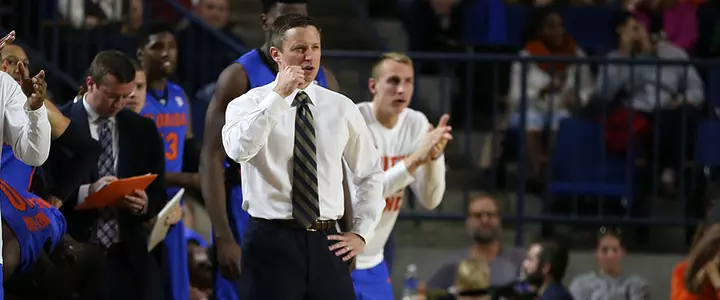
Turnovers Early Issue for Gators
Monday, November 16, 2015 | Men's Basketball, Chris Harry
GAINESVILLE, Fla. -- Turnovers were a big part of Mike White's coaching tenure at Louisiana Tech.
Forcing them, that is.
In Florida's season-opening victory Friday at Navy, the Gators coughed up 19 turnovers, including seven in the game's first eight minutes. Yes, UF righted itself -- somewhat -- on the way to a 59-41 victory, but when coupling those 19 giveaways with the 23 the Gators let go in an exhibition game against Division II Florida Atlantic eight days earlier, it's not unfair to say a pattern, even with the small sample size, is developing.
“It's a problem,” senior forward Dorian Finney-Smith said. “Our coaches talk all the time about turnovers, so we have got to work on them.”
As far as White and his staff are concerned Monday night would be an excellent place to start, when Florida (1-0) plays its home opener against North Carolina A&T (0-1) at the O'Connell Center. The Aggies will be severely outmanned, having lost by 41 at 23rd-ranked Purdue. As far as White's concerned, though, the opponent means nothing. One of the immediate goals of this team is to eliminate mistakes.
And reducing turnovers from 30 to a mere 19 isn't the kind of progress the Gators are looking for.
“We have to value the ball more,” junior point guard Kasey Hill said.
It starts with passing.

After the weekend, UF used its practice time to dust off some basic, fundamental passing drills. In the exhibition and real games, the Gators have been off target with too many passes, especially ones into the post. Too often, when their center -- be it John Egbunu or backup Schuyler Rimmer -- had his defender boxed out and presented a hand as a clear target, entry passes were thrown too far into the body; close enough for the defender to impede it.
“They've been poor passes, just rushed kind of, like straight bullets, instead of throwing it up and letting them go catch it,” Hill said. “[We're] just throwing it too fast into them.”
Or staring the target down too much and telegraphing intent. That's been an issue, as well.
And there have been some lazy passes too. Finney-Smith basically threw the ball to a Midshipman at midcourt during one painful-to-watch sequence that led directly to a Navy 3-pointer. It cut UF's lead to 10 four minutes into the second half, the narrowest lead of the period.
Good thing the Gators answered with six straight points.
“As a leader and a senior, it starts with me,” Finney-Smith said. “I had five turnovers myself.”
Four of UF's five starters had at least three. Hill was the only Gator with more than one assist.
At Louisiana Tech, White's teams were annually among of the best in the country in assist-to-turnover ratio, as the Bulldogs led their conference in that stat the last three years.
So far at Florida, his team is 8-to-19.
Now, some of the credit has to go to Navy's defense. The Midshipmen not only were disciplined, but their 3-2 match-up zone -- which is really hard to carve up with interior passes -- was something the Gators did not handle well.
In other words, UF can expect to see it again, at least until the Gators prove they can play against it.
“Obviously, if you have eight or 10 good passers you're going to have a good passing team. I don't think that's what we are. It's not our biggest strength right now,” White said. “But I do think we're a willing passing team. I don't want people to think we have selfishness creeping in. We make extra passes and turn down good shots to get better shots. We just don't always see it as well as I wish we [would] see it.”
That doesn't mean things can't change. Remember, with Alex Murphy sidelined with plantar fasciitis, the Gators have only four players back from last year's team and are meshing them with eight who weren't on the team last year. Developing chemistry over the summer and in the preseason can only go so far.
These guys need more minutes on the floor together. In real games.
But they need to play crisper, sounder and more error-free.
“Overall, as a team, we have to continue to develop our ability to pass to each other when we're open -- on time and accurately,” White said. “But every team in the country, at this point, is realizing what their strengths and weaknesses are. It's a process. We hope in a couple months to be a better passing team than we are right now.”
Preferably a couple weeks. Better yet, days.