Great Expectations: Kasey Hill Dogged By More Than Opposing Defenses
Saturday, March 7, 2015 | Men's Basketball, Chris Harry
LEXINGTON, Ky. -- As a freshman, he played a lot of basketball for the Florida Gators. Twenty-two minutes per game, in fact, with eight starts. Kasey Hill actually tied an NCAA Tournament freshman record held by both Magic Johnson and Jason Kidd when he dished 10 assists in a Sweet 16 round defeat of UCLA. He averaged 5.5 points and 3.1 assists while backing up and sometimes playing alongside Southeastern Conference Player of the Year Scottie Wilbekin all the way to the Final Four.
What a run it was.
Then it was over, Wilbekin was gone, and UF's playmaking responsibilities -- with all that entails under point guard taskmaster Billy Donovan -- fell to Hill full time.
“When I started the season, I had one thing on my mind and that was to run the team the way Scottie did,” Hill said. “Not saying that we're the same player, but I just thought that was something I could do and needed to do.”

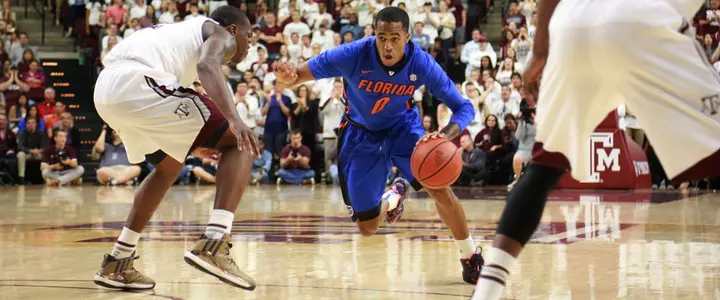
Point guard Kasey Hill looking to justify the unrealistic expectations that went along with his prep All-American resume.
Consider the irony here.
From the moment Hill was knighted with McDonald's All-American status, the expectations placed on him by the Florida fan base and beyond were completely unrealistic. That's part of the deal, though. Hill, a roadrunner playmaker who helped lead Montverde (Fla.) Academy to the mythical high school national championship, was a heralded, top-10 recruit whose name was lined up alongside the likes of Andrew Wiggins, Jabari Parker and Julius Randle, so the automatic conclusion -- by those outside the UF program -- was that he was an Alan Iverson-type franchise player in waiting.
Now, roll on top of those external expectations Hill's internal ones of stepping into Wilbekin's role and, basically by osmosis, being the type of player Wilbekin was in leading the Gators to back-to-back Southeastern Conference championships.
“Yeah,” he shrugged. “That's what I thought.”
As UF (15-15, 8-9) prepared this week for its Saturday showdown against No. 1-ranked and unbeaten Kentucky (30-0, 17-0) inside that McDonald's All-America factory known as Rupp Arena, Hill was able to reflect back on last summer and the run-up to the season with a different perspective.
Rude awakenings usually double as reality checks.
“Scottie was here four years. He understood everything about what we do. He knew exactly what Coach D wanted and knew exactly how Coach D coached. Basically, he was like Coach D on the floor,” Hill said. “I mean, he'd led the team to Elite Eights and the Final Four. He'd been in at the end of games and hit all those big shots.”
Hill shrugged.
“What had I done, really?”
Been a good, solid rookie role player on one of the greatest, deepest and most experienced teams in school history, that's what. Pretty good starting point.
Where everything went sideways was the assumption Hill would take the ball and run with it like the guy before him.  The guy now playing professionally on the other side of the world.
“In some ways I can relate to what he's going through, but in others I really have no idea what he's going through,” Wilbekin (pictured right) told GatorZone.com this week as he looked to lead Cairns Taipans into the Australian National Basketball League championship series against Sky City NZ Breakers. “I didn't have a big role my sophomore year like he does now. I had two years of experience to get me ready for my junior year and really went through some of the same things he's going through, like trying to figure out when to do certain things. Coach D would yell at me at halftime and I would get down on myself, but I also had a lot of guys around me I could turn to who would talk with me and help make things OK.”
Rewind to the 2010-11 season that ended with a heartbreaking loss to Butler in the Elite Eight. Wilbekin was a freshman who averaged 2.4 points and played 17 minutes per game. That UF team had three senior starters (Chandler Parsons, Vernon Macklin and Alex Tyus), plus a junior point guard who in time would set the school's career assist record (Erving Walker) and an eventual 2,000-point scorer (Kenny Boynton).
Then came 2011-12, which closed with a crushing loss to Louisville in the Elite Eight. Wilbekin, then a sophomore off the bench, carded nearly identical numbers while Walker, plus two junior starters (Boynton and Erik Murphy), a one-and-done freshman NBA lottery pick (Bradley Beal) and up-and-coming sophomore classmate (Patric Young) did the heavy lifting.
In Wilbekin's junior year of 2012-13, he became a full-time starter (after serving a suspension for violating team rules to open the season) on a team with three seniors (Boyton, Murphy, Mike Rosario) in the lineup. Will Yeguete and Casey Prather were there, too.
“I had Pat and Will and Casey and Murph and Rosario and guys like that to talk to,” Wilbekin said. “I was always surrounded by veteran leadership who could help take the pressure off me.”
Those veterans, by the way, were pretty good at putting the ball in the basket, also.
Hill's lean-on seniors this season are walk-ons Jake Kurtz and Lexx Edwards, plus Jon Horford, who transferred from Michigan last summer. His junior-class support system is Michael Frazier II (out the last seven games with an ankle sprain) and Dorian Finney-Smith (hampered early in the season by a broken hand and suspended late in the season for a team rules violation). The latter are the team's top two scorers, yet the Gators have gone lengthy stretches where they weren't at full strength or were missing from the lineup.
Wilbekin's four teams -- all of which made it to the Elite Eight -- hit the 70-point mark an average of 20.5 times per season. The 2014-15 Gators have done it just seven times and only once the last 14 games.
The point guard has a lot of pressure to find open guys to score. He's under even more without a lot of scorers on the floor.
This is hardly to suggest Hill is blameless in what could be UF's first losing season in 17 years. He's had some miserable games shooting from the floor and the free-throw line, plus several turnover-plagued outings.
But he's starting to understand why and maybe accept some the last five months as a learning experience and chance to grow.
“Individually, this has been the worst season I've ever had in basketball, but there's also some good and bad with that. It puts it in perspective,” Hill said. “When everything in your life has come so easily, you don't really know how to battle and fight through adversity. I was almost always the better player on the court and never really struggled, so this year has been a slap in my face. Everything is not going my way, like I've always been used to. It's taught me to fight adversity, fight my expectations, fight this season, and let me try and play with a clear mind.”  When Hill was gaining his reputation as an electric open-floor player on the AAU circuit and later at Montverde, opponents would often extend defenses on him; other high-profile prospects would take it as a personal challenge to guard him, which usually meant guys trying to get up in Hill's jersey.
“That played right into his strength,” Donovan said. “That let him blow past them and play in space.”
As a freshman, Hill wasn't a big part of opponents' game-planning; Wilbekin running the offense was the primary target; or Prather's slashing from the perimeter; or Young screen-setting; Frazier's 3-point marksmanship.
Now coaches are scouting specifically against Hill, which means dealing with pick-and-roll defense, corrals, blitzes and all the tactics they can muster to expose him.
Throw in the fact he's a 6-foot-1 guard who made his hay penetrating and finishing against 6-4 and 6-5 guys back in his AAU glamor days. Now, he's attacking the paint while challenged by 6-10, 6-11 guys and looking for windows around the rim or to open teammates.
They're not always there.
“It can take a guy a couple years to adjust to the length and size and speed and the way it all closes down for a point guard,” Donovan said. “Everyone is bigger, everything happens faster.”
And, frankly, Hill doesn't have the offensive options of his point guard predecessors in Wilbekin and Walker. Five times this season, the Gators have scored in the 50s.
The losses have weighed on the team, but Hill has been especially hard on himself. Too hard, according to his coach. As a former star athlete himself, Donovan recognizes the need to move on from bad plays; as a former star point guard, he knows all too well the importance of doing it for the good of the team.
“He takes in very personally when he doesn't play well and holds onto it too long,” Donovan said. “At times, it becomes an energy drain for him. He gets down, discouraged, upset and disappointed and he wears that. As a point guard, you have to be rock solid, mentally and emotionally.”
Otherwise, the spillover can be devastating.
Like with free throws, for example.
Hill is shooting just 54.4 percent from the free-throw line, and an astounding 44.2 in SEC play. Last year, he was 66.3 percent at the line -- 12-for-14 in the NCAA Tournament, which is 85.7 percent -- which only confirms these problems are between his ears.
“Last year, I went to the free throw line and felt so relaxed,” Hill said. “Once this year came, and once I started to shoot so bad, I was trying to fix everything. I wasn't shooting my normal shot. I've never been a terrible free-throw shooter. I was just trying to do so many different things that my mind was racing, trying to get my mechanics right. Too much going on in my mind.”
The Florida coaching staff believes in Hill and therefore has faith there is a better, more consistent and mentally tougher version that awaits.
“As far as his development, he may not be as far along as a lot of people expected him to be,” Gators assistant Matt McCall said. “But just because it doesn't happen his first or second year, doesn't mean there's anything wrong with that.”
The only thing that makes it “wrong” are the expectations that accompanied Hill before he ever set foot on UF's campus.
From the time Hill was five years old, he dreamed of being a McDonald's All-American. He watched guys like LeBron James, Chris Paul and Rajon Rondo dominate that game and become the biggest names in the NBA. He'll neither regret nor apologize for being selected as one of the elite.
“It put more pressure on me to produce on the court,” he said. “I understand that.”
And he'll live with it.

Hill believes his struggles and growing pains of this season will make him stronger in his coming seasons.
The Donovan-era Gators, with all that championship hardware, have thrived with players who have advanced through the system at the program's pace. Now comes a guy with a big résumé, but apparently needs a similar timeline in his development.
“Players like me, like Casey or Will, we were just blue-collar guys who did what we could and got better as the years went on,” Wilbekin said. “It's so polar-opposite of what Kasey's had to deal with.”
The curse of great expectations.
“I'm very hard on myself and sometimes that comes up and bites me,” Hill said. “I never expected the season to be like this. I thought I'd play better. I thought our team would be better. Instead, it's been a struggle. But the one thing I can control is to continue to work, listen to Coach and try to get better.”
Donovan has said many times that no athlete or team ascends to greatness without at one time experiencing great disappointment. He has a term for it.
Rock bottom.
Hill has been there.
“If I hadn't, I probably would never have understood what he was talking about,” Hill said. “But once you're there, there's no place to go but up.”
Somewhere inside him, there is a far more confident, crafty and capable player weighted down by the expectations of others. Kasey Hill must shed the burden.
In time, he'll climb. That's what his team believes.
It's up to Kasey Hill to believe it, too.
“I'll be better because of this experience,” he said. “More important than that, our team will be better because of it.”