Ray Graves Remembered for Impact on Gators and Lives of His Silver Sixties Players
Monday, June 8, 2015 | Football, Scott Carter

GAINESVILLE, Fla. -- They came to Ben Hill Griffin Stadium on Sunday afternoon to pay their respects to former Gators head coach and athletic director Ray Graves, one of the most respected and beloved figures in UF sports history.
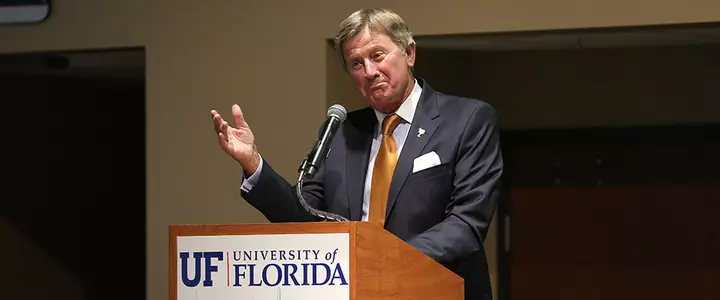
More than 60 of Graves' former players from the 1960s showed up to say their final goodbyes, including Steve Spurrier, who spearheaded Florida's success under Graves and won the Heisman Trophy in 1966.
Some remain in good health, others hobbled by age, but all thankful for the impact the man known as the original Bull Gator made in their lives.
"It was the Silver Sixties Gators who were the passion of his football coaching career,'' said Gene Peek, who played for Graves in the late '60s. "Coach Graves was a great person, and by any and all possible measurements, if you gauge the man. We all know it was Coach Graves who was the glue that kept us together."
Spurrier spent 15 minutes reflecting on his close relationship with Graves. When Spurrier returned to his alma mater in 1990 to become head coach, one of the first things he did was institute the Ray Graves Award to honor the team's Most Valuable Player.
When Spurrier earned his 71st win at Florida, passing Graves as the school's all-time leader, he presented his former coach with the game ball. When the Gators won the 1996 national championship, Graves received a ring.
Spurrier's tribute mixed humor and sincere gratitude. He knew Florida was the place for him -- and that Graves cared about his players -- when he became ill on his recruiting trip to Florida in 1963.
Graves arranged for a private plane to fly Spurrier home to Johnson City, Tenn., so he could see his family and receive medical care.
"This coach really likes me,'' Spurrier said. "He is taking care of me. I told my parents I'm going to Florida. The direction of my life is what it is because of Coach Graves, there's no doubt it.
"He was the best head coach I could have ever played for. Not only did he let me call the plays, he let me make up the plays every now and then."
Former Florida lineman Bill Carr, who played for Graves and later served as UF's athletic director, said the Spurrier-Graves connection was unique.
"The relationship between those two men was extraordinary '' Carr said. "Those who were around benefited and learned from it."
A crowd of approximately 250 attended the memorial service for Graves, who died April 10 at the age of 96. He was Florida's football coach and athletic director from 1960-69, and served 10 more years as athletic director after his coaching career ended. Graves' wife of 72 years, Opal, was unable to attend. Their three daughters represented the family.
Graves not only made an impact on his players, whom he referred to as "my boys," but a young intern in the ticket office named Jeremy Foley.
A New Hampshire native with dreams of running the Boston Red Sox one day, Foley took a six-month internship at Florida in 1976. When the internship was up, he talked to Graves about his future and was offered a job in the athletic department for $11,000 a year.
Foley negotiated a $2,000 salary increase and began his career at UF, where he has spent 39 years, the last 23 years as Florida's athletic director.
He thanked Graves many times over the years, and did so once more Sunday.

"I thank you for allowing a boy from the North to live out his dreams in the South,'' said Foley as he closed his remembrance speech. "A boy who wanted to be the general manager of the Red Sox, but who you gave the opportunity and guidance to one day be the general manager of the Gators. Thank you for changing my life."
All-Americans Carlos Alvarez, Guy Dennis, Steve Tannen, Bill Carr and Larry Smith were some of the notable former players in attendance. Current Gators head coach Jim McElwain also attended.
As Foley moved up the administrative ladder at the University Athletic Association, it was nothing unusual for Graves to call to offer congratulations after another signature moment for the Gators.
When Foley was named athletic director in March 1992, Spurrier was the first person to call. The second was Graves.
Foley thanked him, knowing that Graves helped pave the way.
"He laid the foundation for what has become one of the nation's finest athletic programs," Foley said. "All great programs start somewhere, and I truly believe all this started with Ray Graves. His fingerprints are all over the University of Florida Athletic Association, and people such as myself and coaches who have come through here have benefited from what he did and what he meant to this program."

Norm Carlson, a UF historian and former sports-information director, knew Graves for more than 60 years. When Carlson was a sports writer with the old Atlanta Journal, he would cover Georgia Tech practices once a week.
Georgia Tech coach Bobby Dodd wasn't big on talking to the media as Carlson quickly found out.
"Go talk to Coach Graves,'' Carlson was told.
A Georgia Tech assistant at the time, Carlson and Graves developed a deep friendship that led Carlson back to his alma mater in 1962.
"He's been one of the great influences of my life,'' Carlson said. "He changed my life."
That was the dominant theme Sunday.
Graves made a difference in the lives of people he met, none more than his players.
Another member of the Silver Sixties, Wayne McCall, led a rendition of "We Are The Boys From Old Florida,'' near the end of the service. Graves had requested it prior to his death.
In closing, former Gator Allen Trammell recalled how at the end of each practice, Graves would gather the team for a meeting on the field.
The players would huddle in a circle on one knee and then Graves would shout, "Get in," signaling time to get inside.
As the Silver Sixties said a last goodbye to Graves, they offered one final "Get in" to their coach.
"Those two words will always penetrate my mind and body as long as I live,'' Trammell said.
![Images from the Florida Gators August 2024 Graduation event on Friday, August 9, 2024 at the Stephen C. O'Connell Center in Gainesville, FL. [Photo: Matt Pendleton Photography for Florida Gators Athletics]](https://images.sidearmdev.com/resize?url=https%3A%2F%2Fdxbhsrqyrr690.cloudfront.net%2Fsidearm.nextgen.sites%2Fgatorzone.com%2Fimages%2F2025%2F4%2F30%2FCap_commencement_detail_240809_1400_Matt_Pendleton_Photography_for_Florida_Gators_Athletics__1_.jpg&height=340&type=webp)


