
Senior point guard Chris Chiozza is pound-for-pound the stronger player on the Florida basketball team.
Gator Gains: Time to Put Offseason Strength Work to Test
Thursday, October 5, 2017 | Men's Basketball, Chris Harry
Our annual "Before & After" data from UF men's basketball.


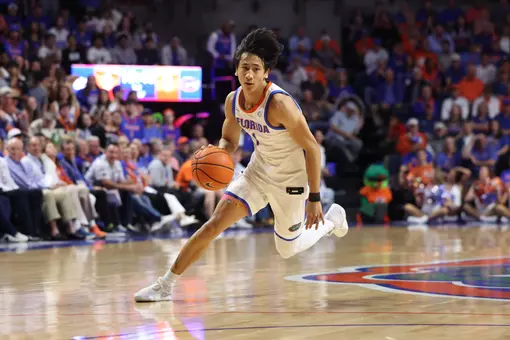
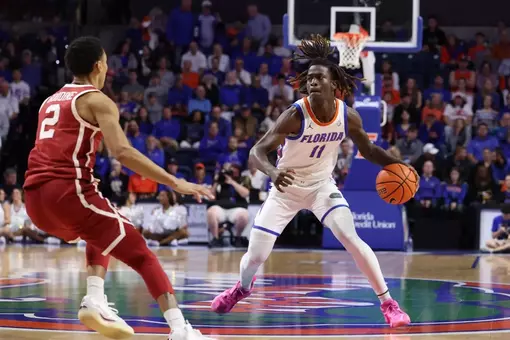
Since strength and conditioning coordinator Preston Greene joined the program in the summer of 2011, the weight room at the UF basketball facility has become a factory of eye-popping physical transformations. His annual "Before-and-After" photos — with examples below — are testament to that.
The "Befores" represent when the players first arrived on campus, be it as freshmen or otherwise.
The "Afters" are the most recent shots. In this case, Greene snapped earlier this week as the Gators looked to the official start fall practice -- which opens Thursday afternoon -- and the shots are telling indicators of the work put in during the offseason. And, as everyone knows, players are made in the offseason. In this case, they're carved up and molded.
"The guys always want to see these pics," Greene said.
But I get 'em first.
Some data to consider as you scroll through:
* Senior point guard Chris Chiozza showed up as a fairly frail (albeit tough) 160-pound kid from Memphis, Tenn. He's now 180 pounds. "Believe me," Green said, "that's not like putting 20 pounds on Gak." Chiozza's bench press of 265 pounds (up from 190 when he got here) makes him the strongest pound-for-pound player on the squad. He also increased his vertical jump from 31 to 35 inches.
* Speaking of Gorjok Gak, the 6-foot-11 sophomore center, he arrived late last summer, gaining eligibility in time for the fall semester, but missing Summer "B," so he was behind. He could do one chin-up. One. Now, he can do eight. Gak's body fat has gone from 16.5 percent to 10. As far as his bench — and this is interesting — Gak only did 95 pounds at his initial assessment. Greene, though, figured out that Gak's enormous hands (see below) and circumference of the bar were a mismatch, so he swapped the normal bar for a thicker, 2-inch diameter bar. Gak threw up 170 with the thicker bar. Now, his bench is 205 pounds.

* Junior center Kevarrius Hayes weighed 199 when he got here two years ago. He's 227 now. That's 28 pounds of muscle, by the way. His bench press is up from 195 to 235 pounds. Before you give that latter digit anything resembling the stink eye, remember that Hayes has a 7-1 wingspan. That's a long way to push the bar.
* Junior guard KeVaughn Allen has the best vertical jump on the team: 39 1/2 inches.
* Freshman point guard Mike Okauru is on Allen's heels at 38 1/2. Interesting note on Okauru, he tends to slump some when he walks, so his training was geared toward improving his posture and help him stay upright.

* Junior swingman Jalen Hudson, the transfer from Virginia Tech, was a workout warrior during his NCAA sit-out season. If you redshirt in the Florida program, by design or for medical reasons, you spend more time in the weight room. Period. Example: On normal game days, be it home or away, you're scheduled to train in the weight room. Hudson embraced that. Not only does his torso look like a road map, he improved his vertical jump by 3 1/2 inches in just one year — from 35 to 38 1/2 inches.
* Sophomore forward Keith Stone did a sit-out season two years ago, opting to redshirt for development purposes, instead of picking up five minutes here and there in a front court that was fairly deep and headlined by Dorian Finney-Smith. Great decision. Stone's physical transformation was evident during his redshirt freshman campaign last year, but now he's in even better shape, having gone from 15 percent body fat to just 8.5 percent. He also added length strength by gaining 100 pounds on his front squat — from 190 pounds to 290 — which he'll need as he enters the season projected to start at the power forward spot.
And, finally, in a development very much relating to strength and conditioning, UF introduced the WHOOP system into its men's basketball program over the summer. WHOOP is a performance optimization system that tracks exertion, sleep and recovery with data that is monitored, in the Gators' case, by Greene. WHOOP measures physiological markers to indicate personal readiness to perform each day, calculates what the body has put into workouts and daily lifestyle to prepare for optimum training, and relays how much sleep is needed to recover while breaking down the quality of each player's sleep.
And the way these guys train, they need their sleep.
"If they don't adjust their strain to meet recovery score, the chances of injury goes up, power output drops and athleticism decreases," Greene said. "We want to monitor that so we can make adjustments as needed."
The goal is to get results ... like these.



Players Mentioned

G
/ Men's Basketball
G
/ Men's Basketball
C
/ Men's Basketball
F/C
/ Men's Basketball
G
/ Men's Basketball
G
/ Men's Basketball
F
/ Men's BasketballFlorida Lacrosse | Coach O'Leary and Theresa Bragg 4-30-26
Friday, May 01
Road to Gameday: Florida Football
Thursday, April 30
Ava Brown: Carwash Convos
Wednesday, April 29
Kaitlyn Davies: Carwash Convos
Monday, April 27


