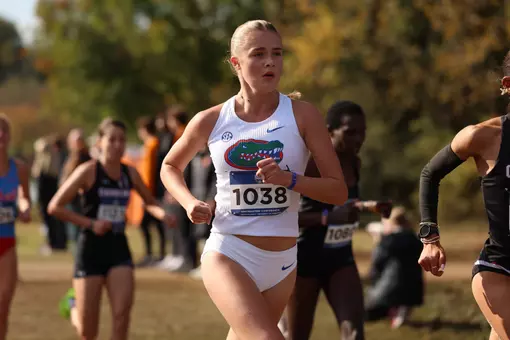
Imogen Barrett (left), Elisabeth Bergh (center), and Morgan Hull (right) with their All-South Region medals.
Tougher Together: Inspirational Stories Power Gators to NCAA Championships
Thursday, November 15, 2018 | Cross Country
Share:
"You see them being able to handle more adversity than they would have a year or two years ago. It just shows that toughness together.” --Chris Solinsky, assistant coach
By: Zach Dirlam
MADISON, Wis. – Jessica Pascoe was a bit overwhelmed Tuesday morning. Following a training session, Pascoe's mind turned to an exam she scheduled for 5:30 a.m. Wednesday, along with papers due by week's end. Luckily Pascoe's roommate helped with one of her biggest stressors: picking out dress clothes.
The Gators are attending Thursday's NCAA Cross Country Championships banquet, ahead of Saturday's national title race, and Florida assistant coach Chris Solinsky vetoed Pascoe's idea to wear jeans. (She and teammate Imogen Barrett insisted jeans would be suitable for such an event in their native Australia.)
"It took a while, but we got somewhere," Pascoe giggled as she recounted the shopping trip. "It was like I was a little kid and she was my mum. I was just annoyed because I don't like wearing nice stuff."
The banquet in Madison, Wis., is not exactly something Pascoe and her teammates planned for. And if anyone is compiling nominees for turnaround of the year, these Gators should be atop the list.
A season ago, Florida finished 22nd at the NCAA South Regional Championship, and 13th out of 14 teams at the SEC Championship, with its best runner crossing 58th.
Pascoe won the SEC title this year, leading Florida to a runner-up finish. Redshirt junior Elisabeth Bergh and redshirt senior Morgan Hull earned All-SEC Second Team and All-South Region honors. Barrett, a freshman, also earned an all-region laurel. Senior Caitlin McQuilkin-Bell, another Australian, missed All-SEC and all-region honors by a combined total of eight places, giving the Gators enough depth to finish second at the NCAA South Regional Championship and secure Florida's first berth for the national meet since 2012.
Pascoe was 74th at SECs and did not finish the regional race last season. Bergh spent much of 2017 recovering from a hip injury which required surgery. Hull was turned away as a walk-on in 2016, and did not crack the top 50 at either championship meet last fall. Barrett was at Kenmore State High School in Queensland, Australia. McQuilkin-Bell placed 93rd or lower three times in five career championship races prior to 2018.
Calling all that remarkable would be an understatement.
"It would be really easy for a group like this to say, 'We can't do that. That's a huge step,'" Solinsky said. "They've just embraced it. It's fun to see how much more confident they're getting by just allowing themselves to surprise themselves."
Pascoe following her victory at the SEC Championship.
Solinsky endured his own struggles last fall. Hired in mid-July, there was barely time to implement his training program. Bergh, an All-SEC First Team and All-South Region honoree in 2016, was sidelined. Pascoe battled nagging injuries which drained her confidence. Training looked less like a team activity and more like individually-paced runs. Much of the group was distant from one another away from team activities. The program itself was four years removed from its last top-four finish at an SEC or regional meet, and with the aforementioned issues working against it, coming anywhere near that in his first season looked unrealistic.
An accomplished professional runner and fierce competitor, he admitted there were a couple times he simply wanted the season to end.
Rather than dwell on championships being out of reach, Solinsky focused on improvement and breaking down barriers within the team. Florida's men and women set a total of 21 personal records in Solinsky's first season. In-house issues were addressed, enabling the Gators to move forward collectively.
"It certainly wasn't easy," he said. "But I thought they did a good job of buying into a new program, going through their lumps. Seeing how close they've become … night and day how much they get along and enjoy spending time with each other."
The culture turnaround provided Pascoe a support system whenever injuries set her back. At May's SEC Outdoor Track and Field Championships, Solinsky entered Pascoe in the 10,000 meters, a distance she had not run before, and her surprise seventh-place finish—the best by a Gator since 2015—vanquished any remaining self-doubt.
"I feel like I can do anything now. If I can push through that, I can push through anything," Pascoe said. "Plus the support from everybody, it gives that extra motivation knowing you've got so many people behind you, and that each step is a result of everybody's effort."
From Hull's perspective, Pascoe's individual success inspired the rest of the Gators to "reach a little further." But Bergh's and Hull's own comeback stories are equally uplifting.
When Bergh (pictured center left, next to Hull [164]) resumed running last December, her dream goal was to finish the 1,500 meters in less than four minutes and 20 seconds. Her collegiate best was two seconds slower than that. Bergh set a new personal record in March, then followed it up with a third-place finish at SEC Outdoors, helping the Gators capture their first team title at the meet since 2009.
"When I got back, I was celebrating every improvement," Bergh said. "It turned out to be greater than I expected."
Concerns about Hull's low bone density left her unable to walk on to the team in fall 2016.
With collegiate cross country no longer an option, Hull joined Team Florida Track Club, coached by Enoch Nadler, an All-SEC and all-region runner at UF in the mid-2000s. Based on recommendations given by the athletic trainers, Hull also developed better eating habits, improved her strength, and added lean body mass. Running collegiately still felt like a longshot, though.
"My health was the most important thing to me," Hull said. "It's a very serious thing when you have low bone density. I was kind of told I would never be on the team. I had kind of written it off and was running for fun at that point."
Once it was known Florida's distance corps would have a new coach, Nadler encouraged Hull to inquire about a walk-on spot. She called Solinsky shortly after his arrival, and once the athletic trainers and team physician cleared her, Hull joined the team a week after official practices began last fall.
"I remember being so excited it was actually happening," Hull said of her first day with the Gators.
Those three are the shining examples of the team's mantra this season. Tougher together.
As the first meet drew closer, Solinsky sent e-mails with different phrases, centered around two common themes: making toughness a verb, an everyday action rather than a description, and running for a purpose beyond individual success.
While cross country is technically a handful individual performances woven together for a group score, the sport's team aspect is often overlooked. Hence Solinsky's insistence the Gators run together in training sessions and build personal relationships with one another.
"There's always going to be a point—sometimes two or three points—within a race where you have a rough patch and doubt starts to creep in," Solinsky explained. "It's easier to make yourself stay with a teammate … you run with them every day, so you know you can stay with them. It helps to have that reassurance and have that bridge while you're going through that rough patch. As long as you don't lose it mentally, that rough patch goes away."
With Pascoe contending for individual titles, Solinsky pointed to Bergh as the leader of the Gators' critical scoring pack, their No. 2-5 runners. That group predominantly consisted of Bergh, Hull, Barrett, and McQuilkin-Bell.
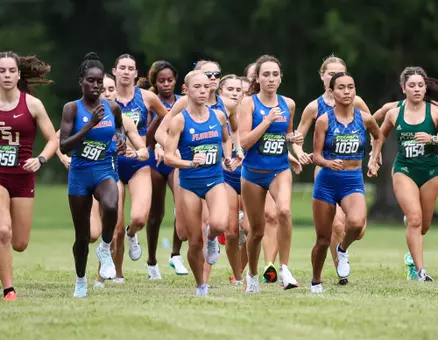
Hull (164) running alongside Barrett (159), just behind McQuilkin-Bell (165).
"It shows if you can be persistent and consistent, you'll get through any ups and downs that a career or life can throw at you," Solinsky said. "As a coach, that's the part I'm most proud of; they're learning life lessons within the season. You see them being able to handle more adversity than they would have a year or two years ago.
"It just shows that toughness together."
The season's recurring theme has been the Gators' ability to surprise themselves, all while Solinsky told them week after week they were an SEC title contender, how they were built to qualify for NCAA Championships.
It appears the same could be true again Saturday. Solinsky continues to say this is a top-10 team, as long as the 21st-ranked Gators have their best day. He drove that point home again at the team's final meeting in Gainesville Tuesday morning.
"It's easier for someone else looking in to see that, but within yourself it's always kind of like, 'Hmm, I don't know,'" Hull said. "We all have our doubts, but as a team, with the past races we've had, we've each gained a little more confidence. It'll take all the pieces getting put together at nationals to crack the top 10, but just enjoying the process is the most important part."
Solinsky saw this coming early in the Gators' summer workouts. Knowing the NCAA Championships were at the University of Wisconsin, where he was a five-time national champion and helped the Badgers to a cross country national title in 2005, Solinsky reviewed races at his old stomping grounds and redesigned the team's workout regimen around his knowledge of the course.
An alumni function could be part of Solinsky's return to Wisconsin as well, but only if none of Florida's activities coincide with it. His college teammates asked numerous times throughout the season whether or not he would attend.
"As much as it would have been nice to go back, I wasn't going unless I had a group," Solinsky said.
Last month, after the Gators won Texas A&M's Arturo Barrios Invitational, Solinsky and his wife, Amy, booked tickets for the trip.
Solinsky knew where he would be this week. The rest of the Gators surprised themselves.