Driven by a strong internal will, redshirt senior Blake Dyer has found success on the links.
By: Hannah Krulevitch
GAINESVILLE, Fla. — When Blake Dyer birdied his final hole at the Gators Invitational it was a surreal moment.
A redshirt senior who had never had a guaranteed spot in the lineup had just helped the Florida men's golf team win its first Gators Invitational title in nearly a decade.
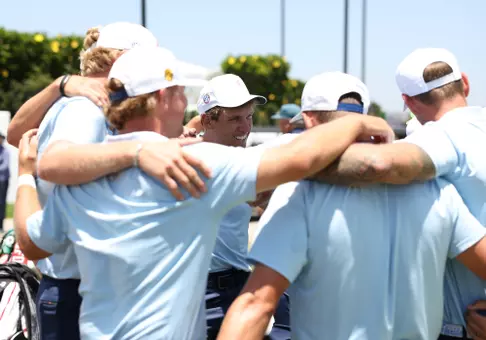
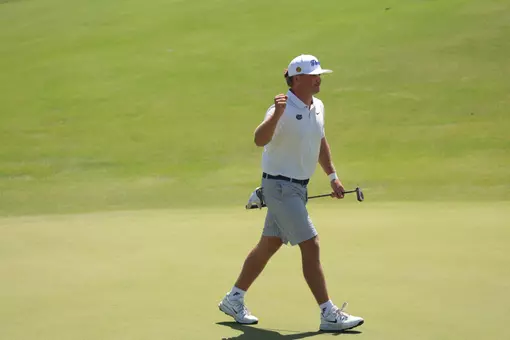
After Dyer sunk his final putt, applause echoed from the temporary bleachers placed around the 18th hole. He put his hand up, acknowledging the fans, then turned and hugged Coach JC Deacon. After shaking hands with the other players in his pairing, he was met on the edge of the green by his family for a group embrace.
A talented player that could have been deterred time and time again in his golf career, Dyer stayed the course and became an impact player as a fifth-year senior.
No one could have known that the most meaningful putt of his UF career would be one of his last.
ALWAYS THERE
A letterwinner for the Florida men's golf program from 1984 to 1988, Dyer's father, Kevin Dyer, was part of the Gators' 1985 SEC Championship team. As such, the Dyer name is sealed in the Florida record book forever; its legacy taking a prominent place in the halls of the clubhouse.
"For me, going to UF and playing the game that I loved was really a dream come true," Kevin said. "It was terrific and very important to the rest of my life."
Growing up with an SEC golf champion father pretty much guaranteed that in some way, golf would be present in Dyer's life. The pressure to play the game, however, was not.
Young Dyer playing around on the golf course
"If my dad had pushed golf on me, I wouldn't be playing golf now," Dyer said. "He just kind of kept it around and slowly the other sports left and golf was there at the end."
Dyer has a younger sister, Sophia, who is 12 and already a gifted player. She competes in high school tournaments and has recorded rounds in the 60s. She agrees that her father's hands-off method when it came to introducing golf was appealing.
"When I was about four or five (my dad) would take me to the golf course and tell me that we could feed the ducks," Sophia recalled. "Even if I didn't play any golf it was just good that I was there, so I could be used to being there. It was very smart because then I just started to love being there."
Dyer was harder to crack than Sophia.
When Dyer was younger, he played a handful of sports — golf, football, baseball and basketball — taking an early liking toward the diamond and the hardwood, and a strong dislike toward the tee box. It did not matter to his parents which sports he played, as long as he was doing something that he was passionate about.
"There's no point in pushing a child who doesn't truly enjoy it and have fulfillment because it will be short-lived," mother Stephanie Dyer said. "You want your children to be fulfilled and happy and have a passion."
So Dyer's parents fed those passions. Kevin became Blake's travel baseball coach. Stephanie would be in the stands cheering, taking photos. Their son's happiness was of the utmost importance to them. Eventually, baseball became too much for Dyer. He was playing on three different teams and there was never time to take a break. He was either at practice or a game or would have to leave a game to make another game. That's a lot for anyone, let alone a middle school boy. Dyer on the mound during his baseball days
It was time to move onto the next thing: basketball.
When he first started playing basketball, in his mind that was it. He played competitively and excelled. He loved it. It was what he wanted to do, he was sure of it. He decided that his new goal was to play at the collegiate level, and his parents were prepared to help feed his new passion.
The next step to playing in college was to try out for an AAU team. Luckily his dad knew the coach of a local squad and they were willing to have him come out. Dyer was ready. He arrived confident. When he walked into the gym, he laced up his shoes and began warming up. After several minutes, the coach called everyone over to give them some instructions before they began.
"If you're going up to the rim and not dunking on everybody's heads then I'm going to pull you out," he said.
Dyer was stunned. He was athletic, but not a dunk-everytime-you-go-to-the-rim type of athletic. Thoughts that he was in the wrong place began racing through his mind,
That moment made Dyer re-evaluate, take a step back. Maybe basketball wasn't where he was supposed to be, just where he wanted to be. Even so, he stuck it out. After a few games with that team, Dyer decided to make an AAU team with his friends instead. They had fun, but were getting destroyed by their competition.
"I realized basketball was probably not in my future," he said.
When Dyer decided the book had been closed on his hoops career, it felt like he was kind of done with sports. Football phased out a while ago, he was burnt out on baseball, basketball was not in the cards and he had not touched a golf club for eight months. His parents were supportive, they did not lobby for him to keep playing, instead they just told him he needed to get a job to fill his free time.
Then, out of the blue, something changed.
"One day I just wanted to go to the golf course, not for any reason, just to hit some balls," Dyer said. "Like five minutes into it I was like 'OK, I want to play golf again,' and then it just took off. I didn't really look back."
PLAYING CATCH UP
When Dyer decided he wanted to seriously pursue golf at the end of his high school freshman year, he was way behind. He was going up against guys that had been practicing golf — and only golf — every single day for hours on end since they were young. A less than ideal situation to be in for someone chasing the same dream as those others.
But the way that Kevin and Stephanie Dyer motivated their children made an ambitious (somewhat daunting) goal seem attainable.
There was a seminar at Dyer's school when he was around five — the age when he started tee ball — that brought in a sports psychologist to talk to parents. This particular psychologist specialized in working with amateur world-class athletes, such as Olympic gymnasts. While most of what he said was interesting, there was one point he made that really struck a chord with Kevin and Stephanie.
The psychologist set up a scenario where "Johnny" hits the winning home run on his baseball team. This action is usually followed up with, "Great hit, Johnny. You won us the game." The remark does not negatively impact Johnny whatsoever. However, there are bigger lessons that can be emphasized in moments like that, or even moments where Johnny strikes out to lose the game, it was explained.
Kevin's interpretation: "If you think about what we're really trying to accomplish, which is finding lessons in sports that apply to the rest of your kids' lives, what would be even more powerful would be to say 'Hey Johnny, isn't it really cool how all the work you've been doing on your hitting paid off?'"
It seems like such a simple thing. Praising a player's hard work, instead of the action itself. But it can make an immense impact and with Dyer, that impact was evident.
Blake and his father Kevin
Still is.
When Dyer began putting his energy toward his golf game he was at the course all the time. He knew the steps he had to take in order to elevate his game. He was steadfast and thinking long term.
"He just has that grit," Stephanie said. "He's tenacious, he never gives up, and if he wants something, he's going to keep going."
Toward the end of Blake's junior year at St. Petersburg High that tenacity started paying dividends. He began making a name for himself as one of the better junior golfers in the state of Florida and was receiving attention from highly touted programs, UF included.
"We had him in on a visit and we really like him," Deacon said. "At the U.S. Junior that year on the 13th hole, I saw him hit a drive that was unbelievable, in the match play portion. That's when it was like, 'This kid can really play.'"
Dyer became a Gator, just like his dad did 30 years earlier.
Hard to script it better than that.
WORK HARD, THEN WORK HARDER
The 2015 Florida men's golf recruiting class was loaded.
Along with Dyer, Deacon had signed Sam Horsfield, Jorge Garcia and Gordon Neale and Kyler Tate. Horsfield, Garcia and Neale were commonly regarded as the "Big Three," all boasting high amateur rankings, as well as impressive resumes before stepping foot on Florida's campus.
For example, Horsfield and Garcia both played in the 2015 U.S. Open, with Tiger Woods, Jordan Spieth and Rory Mcllory in the field. These guys were good.
For most people, competing against players of that caliber for a spot in the lineup may be discouraging, but for Blake it was just another step in his process.
"To get to where I want to go I've got to beat these guys anyways." That was Dyer's stock response when asked about it as a freshman. Dyer playing in the Gators Invitational as a freshman
In the first event of his collegiate career, Dyer made the lineup at the No. 5 spot. After that, he appeared in two more events as an individual.
Dyer entered his sophomore season coming off a summer where he thought he was playing really well. However, he missed the cut for the first tournament of the year.
Before the next tournament, Deacon called him for a sit-down.
Deacon told him that he had a spot for Dyer in the lineup if he wanted it, but that he also thought Dyer should consider redshirting.
"That's probably the deepest team I've ever had," Deacon said of the 2016-17 squad. "There were a lot of guys he had to beat. Not that he couldn't do i. It was just going to be really difficult and there were going to be some tournaments that he missed. I don't think he wanted that. … He got a year to play with those guys and watch how good they were and learn and then I think it was a year he really grew up. He's been a lot different since that year."
A year to grow, mature and develop changed the structure of his life. He built great habits when it came to both practicing as well as working in the classroom. He got more comfortable adjusting to life at college and settling into the program.
Since he redshirted the 2016-17 season, Dyer's work ethic was unmatched, but his spot in the lineup was never guaranteed. Last season, he represented the Gators at the Southeastern Conference championships and NCAA regionals, but the fall of his senior year, he missed the cut for all four of the UF events.
"To be honest, I wasn't even really close to playing (well)," he said. "I just wasn't playing good and a bunch of the guys were playing really well."
Following the fall season, players meet with the coaches for evaluation. In the past, Dyer entered those meetings asking his coaches what he should work on, but this time, he already knew. He told Deacon and assistant coach Mark Leon that he had talked to his swing coach and had a plan. He would be good to go when he got back.
"When I said that they were probably like, 'OK, we'll see,' "Dyer recalled. "But there was never a doubt (in my mind)."
Sure enough, the plan worked.
Over winter break, Dyer's game came together. He finished tied for fifth at the Orlando Amateur, then followed that up with a top-three finish at the New Year's Invitational. And this time, his play in the offseason carried over to qualifying.
He was in the Florida lineup for the first event of the spring at the four spot. Two of his rounds counted to help the Gators claim second among a tough field. He qualified the two tournaments after that, and then he was exempt.
"Coming from playing so bad in the fall to be exempt and not even feeling like I've played my best," Dyer said. "It's satisfying, knowing the work I've put in."
UNEXPECTED ENDINGS, NEW BEGINNINGS
On March 12, the Florida men's golf team's season came to a close — along with all NCAA spring sports, as it turned out — due to COVID-19 pandemic. Dyer, already with five seasons and already with his degree, won't pursue an extra year of eligibility granted to spring student-athletes earlier this month by the NCAA.
Dyer and Deacon embrace at the 2020 Gators Invitational
Other opportunities await.
Dyer and the rest of the team will never know how the season would have played out, but things happen in life that eclipse golf, and right now the world is living through one.
When the dust settles, Dyer's plan is to go to Canada Tour Q School and try to earn status. There is no predicting what will happen as he begins his professional career, but his track record and internal drive hint that he will be successful, and according to Deacon, "that's the most important thing to making it."